Skip to content
Chang Research
Live

MODULE 16 · Handle complex products

Real Case Studies: Five Moments That Taught Indian Investors Hard Lessons

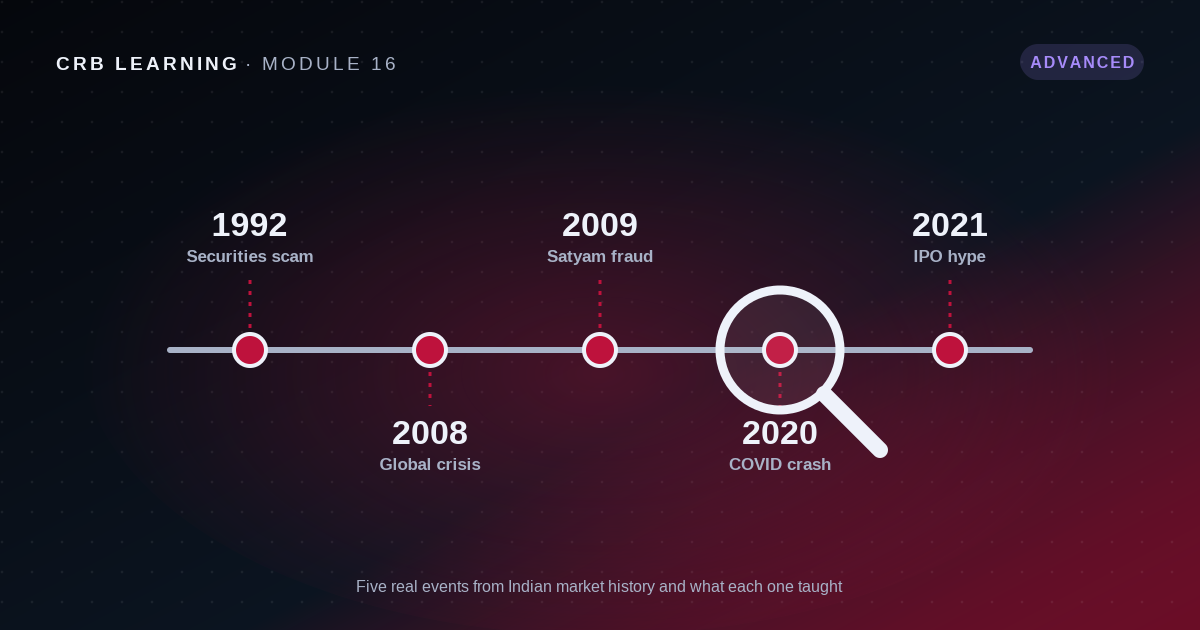
Five real events from Indian market history, from the 1992 scam to the 2020 crash, and the lesson each one teaches.

Advanced8 min readIndia-focused examples

Published by Chang Research Base · Last reviewed · Educational content, not investment advice (disclaimer)

Illustration of a timeline with milestones at 1992, 2008, 2009, 2020 and 2021 under a magnifying glass

Why this matters

Theory is easy to agree with. "Diversify." "Do not panic." "Do not chase hype." Everyone nods.

Then a real crash or a real scam arrives, and people forget all of it.

These five events from Indian market history show what the rules look like when real money and real fear are involved. Figures are historical and rounded.

1. The 1992 securities scam

What happened: In the early 1990s, stockbroker Harshad Mehta used loopholes in the banking system to move bank money into the stock market. With that money he pushed up the prices of selected shares. The Sensex more than doubled in about a year, peaking in April 1992.

When the scheme was exposed that month, the money dried up and the market crashed. Many ordinary investors who had bought near the top lost heavily.

What changed: The scam pushed India to modernise its markets. SEBI was given legal powers in 1992, NSE began electronic trading in 1994 and paper share certificates gave way to demat accounts from 1996.

The lesson: When prices rise far faster than the businesses behind them, ask where the money is coming from. A rally with no real reason can end overnight.

2. The 2008 global financial crisis

What happened: A housing loan crisis in the United States brought down large global banks. Foreign investors pulled money out of markets everywhere, including India.

The Sensex had crossed 21,000 in January 2008. By late October 2008 it had fallen below 8,000, a drop of about 60% in ten months. India's own economy was in far better shape than the fall suggested.

What came next: The market began recovering in 2009 and the Sensex was back above 21,000 by late 2010.

The lesson: Global events can hit Indian stocks hard even when Indian companies are fine. Investors who had borrowed money or needed their cash soon were forced to sell at the bottom. Those with an emergency fund and a long time frame could wait.

3. The Satyam fraud, 2009

What happened: Satyam Computer Services was one of India's largest IT companies and part of the Nifty. On 7 January 2009, its chairman admitted in a letter that the company's accounts had been falsified for years, including cash that did not exist.

The share price fell by nearly 80% in a single day. The government stepped in, replaced the board and the company was later taken over by Tech Mahindra.

The lesson: A big name, index membership and audited accounts are not a guarantee. Even careful investors could not have seen this fraud from outside. The only real protection was diversification: someone with 5% of their money in Satyam was hurt, someone with 50% was ruined.

4. The COVID crash, 2020

What happened: As the pandemic spread and lockdowns began, markets fell at record speed. From its January 2020 high to its low in late March 2020, the Nifty 50 lost nearly 40% in about two months. Trading was halted twice in March when the index hit its lower circuit.

What came next: Nobody knew how bad things would get, and many people sold everything. Then the market turned. By November 2020 the Nifty was back at a new all-time high.

The lesson: Panic selling turns a temporary fall into a permanent loss. Investors who kept their SIPs running through March and April 2020 bought units at very low prices. This does not mean every fall recovers quickly. It means your plan should be made before the crash, not during it.

5. The Paytm IPO, 2021

What happened: In November 2021, at the peak of an IPO boom, Paytm's parent company raised about ₹18,300 crore in what was then India's largest IPO. The issue price was ₹2,150 a share.

On listing day the stock closed about 27% below the issue price. It kept falling in the following months and stayed far below the issue price for years.

The lesson: A brand you use every day is not automatically a good investment at any price. The company was loss-making and the valuation was high, and both facts were in the prospectus. In hot markets, hype travels faster than analysis. Read our IPO lesson for how to check an issue yourself.

The patterns that repeat

Different decades, different triggers, same human behaviour.

EventThe emotionThe protection
1992 scamGreed in a rally nobody questionedAsk what is driving the price
2008 crisisFear, and forced sellingEmergency fund, no borrowed money
SatyamBlind trust in a big nameDiversification
COVID crashPanicA plan made in advance
Paytm IPOHype and FOMOChecking valuation, reading the prospectus

Real-world example

Example: two investors in March 2020

This scenario is illustrative, based on how the market actually moved.

Farhan had no emergency fund and had put all his savings into stocks in January 2020. When his portfolio was down more than 30% in March and his income became uncertain, he sold everything to feel safe. He locked in the loss and missed the recovery that followed.

Lakshmi had six months of expenses in the bank and a monthly SIP in an index fund. Her portfolio fell just as much on paper. She did nothing except let the SIP continue. By the end of 2020 her portfolio was above its January level.

They owned similar investments. The difference was preparation: a cash cushion, money she did not need soon, and a plan she did not have to rethink in the middle of a crisis.

Key terms and what they mean

Bull run
A long period of rising prices and optimism.
Crash
A sudden, sharp fall in prices across the market.
Bubble
Prices rising far above what the underlying businesses justify.
Circuit breaker
An automatic trading halt when the index moves 10%, 15% or 20% in a day.
Corporate governance
How honestly and responsibly a company is run for its shareholders.
Valuation
How expensive a share is relative to the company's earnings or assets.
Panic selling
Selling in fear during a sharp fall, usually at low prices.
Contagion
When trouble in one market spreads to others.

Benefits, risks and limits

What is good about it

  • History shows what risk actually looks like, beyond definitions.
  • It prepares you emotionally for falls that will happen again.
  • It highlights the few habits that protected investors every time.

Risks and limits

  • Hindsight makes past events look obvious. They were not obvious at the time.
  • The next crisis will have a different cause and may not recover on the same timeline.
  • A few famous cases do not cover every kind of risk.
  • Past recoveries are not a promise of future recoveries.

Common mistakes beginners make

  1. Believing "this time is different" at the top of a boom.
  2. Assuming every crash will bounce back within months.
  3. Concentrating money in one stock because it is a household name.
  4. Investing borrowed money or emergency cash.
  5. Studying only success stories and never the failures.

Key takeaways

  • Crashes, frauds and hype cycles are a normal part of market history.
  • Diversification is the only defence against risks you cannot see.
  • An emergency fund lets you hold on when others are forced to sell.
  • Make your plan in calm times. Follow it in scary ones.

Frequently asked questions

What was the biggest stock market crash in India?

Among the sharpest were the fall after the 1992 securities scam, the 2008 global financial crisis, when the Sensex fell about 60% from its peak, and the COVID crash of early 2020, when the Nifty 50 lost nearly 40% in about two months.

How long does the market take to recover after a crash?

It varies a lot. After the March 2020 low, the Nifty reached a new high within about eight months. After the January 2008 peak, it took nearly three years. There is no fixed timeline, which is why money needed soon should not be in stocks.

How can I protect my portfolio from a company fraud?

You usually cannot detect a well-hidden fraud from outside. The practical protection is to diversify so that no single company is a large part of your portfolio, and to be cautious when governance warning signs appear.

Should I sell everything when the market crashes?

Selling in panic often locks in losses near the bottom. A better approach is to decide in advance how much risk you can handle, keep an emergency fund in cash and invest only money you will not need for several years.

Sources and further checking

Examples use made-up or rounded numbers unless a date and source are given. Rules, rates and contract details change, so confirm them with the official source before acting. This lesson is for education only and is not investment, tax or legal advice. See the disclaimer.