Skip to content
Chang Research
Live

MODULE 09 · Build real skill

Trading Psychology: Why Your Brain Is Your Biggest Risk

Fear, greed, FOMO and revenge trading. Learn the mental traps that empty accounts and simple rules to stay disciplined.

Intermediate7 min readIndia-focused examples

Published by Chang Research Base · Last reviewed · Educational content, not investment advice (disclaimer)

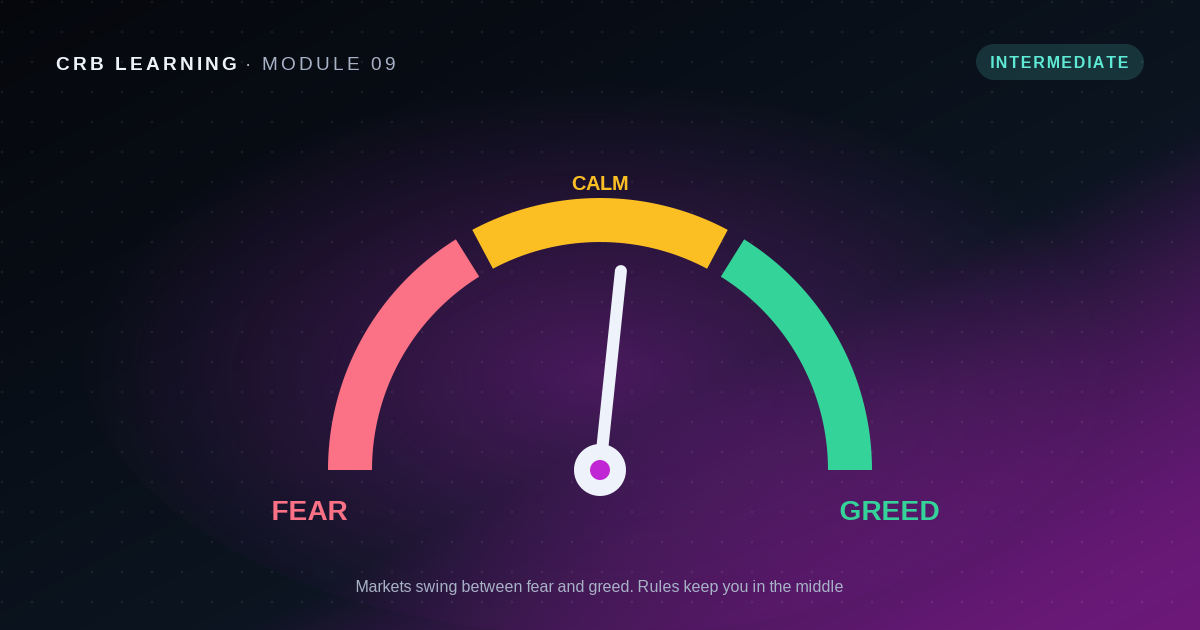
Illustration of a dial with a needle swinging between fear on one side and greed on the other

Why this matters

Two people can get the same trade idea and end up with opposite results. The difference is rarely the idea. It is how they behave after clicking buy.

Your brain was built to run from danger and follow the crowd. Those instincts kept our ancestors alive. In markets, they make you buy high and sell low.

You cannot delete emotions. You can learn to spot them and build rules that hold when your feelings do not.

The two forces: fear and greed

Almost every trading mistake comes from one of two feelings.

  • Greed says: "This is going up forever, buy more." It shows up near market tops.
  • Fear says: "Get out before it goes to zero." It shows up near market bottoms.

Prices themselves are often just the crowd's fear and greed drawn on a chart.

Six mental traps to know by name

  • FOMO (fear of missing out): jumping into a stock because it already went up and everyone is talking about it. You usually arrive late.
  • Loss aversion: losses hurt roughly twice as much as equal gains feel good. So people hold losing trades hoping to "get back to even" and sell winners too early.
  • Revenge trading: taking a bigger, rushed trade right after a loss to win it back. One loss turns into three.
  • Overconfidence: a few wins make you feel skilled, so you increase size and drop your rules.
  • Confirmation bias: you only read news and opinions that agree with the position you already hold.
  • Anchoring: being stuck on one price, like the price you paid. The market does not know or care what you paid.

The herd effect

When a stock is trending on social media, it feels safe because so many people agree. That feeling is the trap.

By the time a tip reaches your family WhatsApp group, the early buyers are often looking for someone to sell to.

A useful question: "Would I buy this if nobody had told me about it?"

Build a system that protects you from yourself

  1. Write a plan before every trade: entry, stop-loss, target and quantity. Decisions made in advance are calmer than decisions made live.
  2. Fix your risk per trade. Small, equal risk keeps emotions small. See risk management.
  3. Set a daily loss limit. For example, stop for the day after two losing trades.
  4. Take a break after a big win or a big loss. Both distort judgment.
  5. Trade less. No trade is also a position. Boredom is not a reason to trade.

Keep a trading journal

A journal is the cheapest and most powerful tool you can have. For every trade, note:

  • Why you took it.
  • Entry, stop-loss, target and result.
  • How you felt: calm, rushed, bored, angry?
  • Did you follow your plan? Yes or no.

After 30 trades, patterns jump out. You may find most of your losses happen in the first 15 minutes, or right after another loss. That is information no course can give you.

Real-world example

Example: how one bad morning snowballs

This is a made-up but very common story.

  1. 9:30 am. Rohan takes a planned trade and loses ₹1,000. This is normal and within his limit.
  2. 9:50 am. Annoyed, he takes an unplanned trade with double the quantity to recover. It loses ₹2,500.
  3. 10:30 am. Now angry, he removes his stop-loss on a third trade and holds, hoping. He ends the day down ₹9,000.

His strategy lost ₹1,000. His emotions lost ₹8,000.

With one rule, "stop after two losses", the worst possible day would have been about ₹2,000 at his planned size.

Key terms and what they mean

FOMO
Fear of missing out: buying because others are profiting, not because of your own analysis.
Revenge trading
Trading impulsively to recover a recent loss.
Loss aversion
The tendency to feel losses more strongly than equal gains.
Confirmation bias
Looking only for information that supports what you already believe.
Anchoring
Relying too heavily on one reference price, such as your buying price.
Overtrading
Taking too many trades, usually out of boredom, greed or frustration.
Trading journal
A record of your trades, reasons and emotions used to find and fix patterns.
Discipline
Following your plan even when your emotions disagree.

Benefits, risks and limits

What is good about it

  • Fewer impulsive trades and smaller losing streaks.
  • You learn from your own data instead of repeating mistakes.
  • Less stress, because rules carry the weight that willpower cannot.

Risks and limits

  • Knowing about a bias does not make you immune to it.
  • Discipline is tested most when you are tired, stressed or on a losing streak.
  • Good psychology cannot rescue a strategy that has no real edge.
  • Trading with money you cannot afford to lose makes calm thinking almost impossible.

Common mistakes beginners make

  1. Increasing trade size right after a loss.
  2. Holding a losing trade because selling would make the loss "real".
  3. Checking prices all day and reacting to every move.
  4. Copying trades from social media without a plan of your own.
  5. Skipping the journal because losses are unpleasant to write down.

Key takeaways

  • Most trading damage comes from behaviour, not from analysis.
  • Name the trap: FOMO, revenge, loss aversion, overconfidence.
  • Decide everything before you enter. Follow it after.
  • A journal turns painful losses into useful lessons.

Frequently asked questions

How do I control emotions while trading?

You manage them with structure rather than willpower. Risk a small fixed amount per trade, write your plan before entering, set a daily loss limit and step away after big wins or losses.

What is revenge trading?

It is taking impulsive, often larger trades straight after a loss in order to win the money back. It usually leads to bigger losses, because the decisions are driven by anger rather than a plan.

Why do I sell winners early and hold losers?

This is loss aversion. Booking a small profit feels good, while booking a loss feels painful, so the mind avoids it. Pre-set stop-losses and targets help break the habit.

Does trading psychology matter for long-term investors?

Yes. Long-term investors face the same fear and greed, mostly as panic selling in crashes and overbuying in booms. Automatic SIPs and a written plan help them stay the course.

Sources and further checking

Examples use made-up or rounded numbers unless a date and source are given. Rules, rates and contract details change, so confirm them with the official source before acting. This lesson is for education only and is not investment, tax or legal advice. See the disclaimer.