Skip to content
Chang Research
Live

MODULE 04 · Start from zero

Intraday vs Swing vs Long-term: Which Style Actually Fits You?

Which style fits your time, money and temperament? Compare holding periods, effort, costs and realistic risks.

Beginner6 min readIndia-focused examples

Published by Chang Research Base · Last reviewed · Educational content, not investment advice (disclaimer)

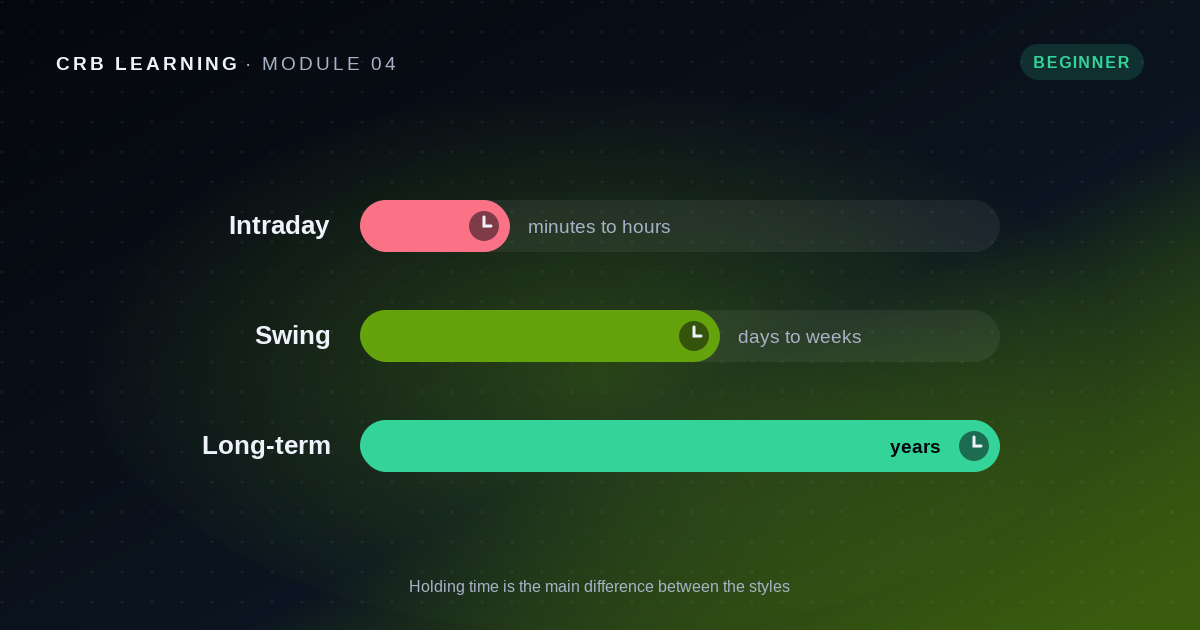
Illustration of three timeline bars of different lengths labelled minutes, weeks and years

Why this matters

"Should I trade or invest?" is the wrong first question. The better question is: how much time, money and stress can you really handle?

Each style of participating in the market asks for something different. Pick one that fights your lifestyle and you will quit, usually after a loss.

The main styles at a glance

StyleHolding timeScreen timeMain toolRisk
ScalpingSeconds to minutesConstantCharts, order flowVery high
IntradayMinutes to hours, closed the same dayMost of market hoursChartsHigh
SwingA few days to a few weeks30 to 60 minutes a dayCharts, some newsModerate
PositionalWeeks to monthsA few hours a weekCharts and fundamentalsModerate
Long-term investingYearsA few hours a quarterBusiness fundamentalsLower, if diversified

Intraday trading

You buy and sell on the same day. Nothing is carried overnight. If you do not close the trade, your broker closes it for you before the market shuts.

Brokers allow leverage for intraday, meaning you can take a position bigger than your cash. This is what makes it exciting and dangerous. Leverage multiplies losses just as much as gains.

The hard truth: a SEBI study of the equity cash segment found that about 7 out of 10 individual intraday traders lost money in FY 2022-23. Costs and fast decisions work against beginners.

Swing and positional trading

Swing traders try to catch one "swing" in price that plays out over days or weeks. Positional traders hold for weeks to months.

You take delivery of the shares, so there is no forced exit at 3:30 pm. You can do your analysis in the evening and place orders with a stop-loss.

This style suits people with jobs or college. The trade-off is overnight risk: bad news can make a stock open far below your stop-loss.

Long-term investing

You buy good businesses or broad funds and hold for years. You care about the company's earnings, debt and growth, not today's price.

It needs the least screen time and has the lowest costs, because you trade rarely. Long-term capital gains are also taxed at a lower rate than short-term gains.

The challenge is emotional. You must sit through falls of 20% or 30% without panic selling. Markets have always had those falls.

How to choose

Ask yourself four honest questions:

  • Time: Can you watch the screen from 9:15 am to 3:30 pm? If not, intraday is out.
  • Money: Is this money you can afford to lose? If not, do not trade it.
  • Temperament: Does a 5% loss ruin your day? Shorter styles will hurt more often.
  • Skill: Have you tested your method on past charts or with tiny amounts?

Many people settle on a mix: a long-term core through index funds or SIPs, plus a small "learning" amount for swing trades.

Real-world example

Example: three friends, one stock

Three friends like the same company. The numbers are illustrative.

  • Kabir (intraday) buys at 10 am with 5 times leverage and must exit by the afternoon. A 1% fall in the stock means a 5% loss on his own capital. He watches every tick.
  • Meera (swing) buys for delivery after work, with a stop-loss 4% below her entry and a target 10% above. She checks once in the evening.
  • Dev (long-term) reads the annual report, buys a small amount every month and plans to hold for five years or more. A bad week does not change his plan.

Same stock, three completely different experiences. None is "the best". Each fits a different person.

Key terms and what they mean

Intraday
A trade opened and closed within the same trading day.
Delivery
Buying shares and holding them in your demat account beyond one day.
Leverage / margin
Trading with more money than you have put in, using funds allowed by the broker.
Square off
Closing an open position.
Holding period
How long you keep an investment.
Overnight risk
The chance that news after market hours moves the price sharply by the next open.

Benefits, risks and limits

What is good about it

  • Short styles give quick feedback, so you learn fast.
  • Swing and positional trading can fit around a job.
  • Long-term investing has low costs, lower tax on gains and needs little time.

Risks and limits

  • Leverage in intraday can wipe out capital quickly.
  • Frequent trading adds brokerage, taxes and charges on every trade.
  • Long-term investors face long flat or falling periods and must stay patient.
  • No style guarantees profit. Most active traders underperform simply holding an index fund.

Common mistakes beginners make

  1. Starting with intraday because it looks fastest.
  2. Turning a losing intraday trade into a "long-term investment" to avoid booking the loss.
  3. Mixing styles: using a 5-minute chart to manage a 5-year holding.
  4. Trading with borrowed money or money needed for fees and rent.
  5. Judging a style after two weeks of results.

Key takeaways

  • Pick a style by your time, money and temperament, not by what looks exciting.
  • Shorter holding periods mean more effort, more cost and more stress.
  • Most beginners do better with a long-term core and a small learning account.
  • Decide your style before you enter a trade, and stick to it.

Frequently asked questions

Which is better, trading or investing?

Neither is better for everyone. Investing suits people who want to build wealth slowly with little time. Trading can suit people who have time, tested rules and money they can afford to lose. Many people do both in separate accounts.

Can I do intraday trading with a full-time job?

It is very difficult, because intraday needs your attention during market hours. Swing or positional trading, where you plan in the evening and use stop-loss orders, fits a job far better.

How much money do I need to start trading?

There is no fixed minimum, but start with an amount whose complete loss would not affect your life. Learning with small positions costs far less than learning with big ones.

Is intraday income taxed differently?

Yes. In India intraday equity profits are treated as speculative business income and taxed at your income tax slab rate, not as capital gains. See our lesson on taxes and charges for details.

Sources and further checking

Examples use made-up or rounded numbers unless a date and source are given. Rules, rates and contract details change, so confirm them with the official source before acting. This lesson is for education only and is not investment, tax or legal advice. See the disclaimer.