Table of contents
- 1. Crypto Fundamentals
- 2. Money & Economics
- 3. Blockchain — The Core Technology
- 4. Cryptography
- 5. Bitcoin
- 6. Other Major Cryptocurrencies
- 7. Ethereum & Smart Contracts
- 8. Crypto Wallets
- 9. Crypto Exchanges
- 10. Stablecoins
- 11. DeFi — Decentralized Finance
- 12. NFTs
- 13. Web3
- 14. DAOs
- FA & On-Chain Analysis
- 15. Tokenomics
- 16. Crypto Trading
- 17. Crypto Market Analysis
- 18. Crypto Cycles
- 19. Crypto Security
- 20. Crypto Scams
- 21. Regulation & Government (with a focus on India)
- 22. Crypto & Traditional Finance
- 23. Real-World Applications
- 24. Crypto & AI
- 25. Crypto Infrastructure
- 26. Mining & Staking
- 27. Environmental Debate
- 28. Privacy Coins & Privacy Technology
- 29. Crypto & Geopolitics
- 30. Crypto Failures & Lessons
- 31. Famous Crypto People & Organizations
- 32. Crypto Criticism
- 33. The Biggest Debate: Bitcoin vs. Traditional Finance
- 34. Future of Crypto
- 35. The Ultimate Question
Introduction
This book exists because most crypto content sits at one of two extremes: breathless promotion or blanket dismissal. Neither is useful to a reader trying to actually understand what's happening in this space, why it matters, and where the real risks and real opportunities lie.
The approach here is deliberately even-handed. Every chapter separates what is technically true, what is economically true, what is disputed, and what is simply believed by parts of the crypto community without strong evidence behind it. Where data is cited, it reflects the best available information at the time of writing — crypto moves fast, and readers should treat market figures, regulatory status, and 'current' claims as needing a freshness check before being used in any published or financial context.
The book moves from first principles (what is a blockchain, what is a private key) through the full ecosystem — money and economics, the major chains, DeFi, NFTs, security, scams, regulation with a dedicated look at India, geopolitics, historical failures, and finally the questions that don't yet have settled answers. Each chapter closes with a short data snapshot and a single takeaway line, designed to be genuinely useful as a reference — not just a narrative to read once.
The goal is not to convince you crypto is good or bad. The goal is to leave you able to evaluate any specific claim, project, or headline yourself, using the right questions instead of borrowed conclusions.
Crypto Fundamentals
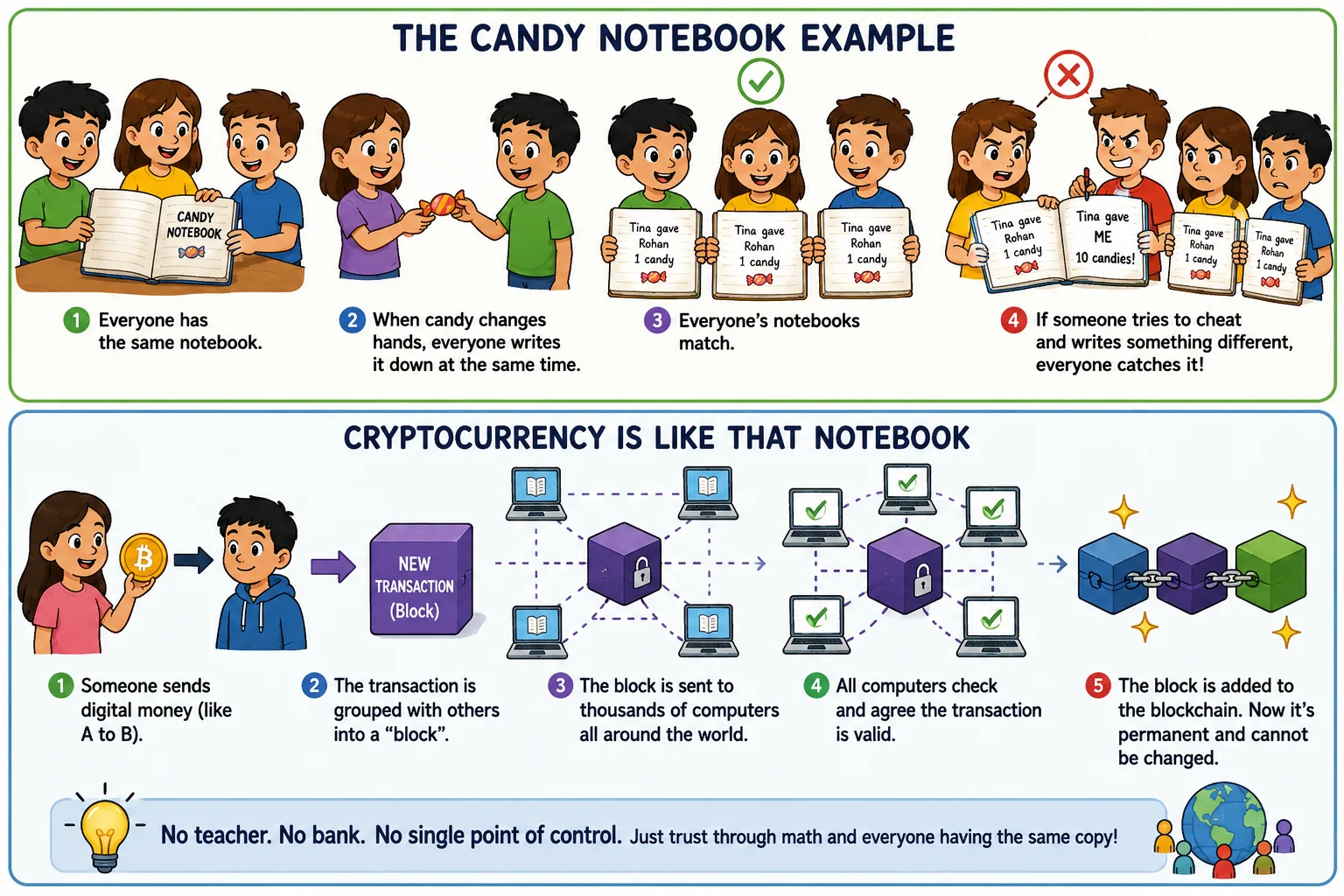
Cryptocurrency is digital money secured by cryptography and recorded on a shared, tamper-resistant ledger instead of a bank's private database. That single design choice — moving the ledger from one institution to a network — is the seed from which almost every other idea in this book grows.
Crypto emerged from a specific complaint about traditional money: every digital payment requires a trusted intermediary — a bank, a card network, a government — to prevent double-spending and to decide who owns what. Satoshi Nakamoto's 2008 Bitcoin whitepaper proposed a way to solve double-spending without a trusted third party, using cryptographic proof and a distributed network of participants who verify each other's work.
A few distinctions matter before anything else makes sense. A blockchain is the technology (a chronological, cryptographically linked record); a cryptocurrency is an asset that lives on one. A coin has its own native blockchain (Bitcoin, Ether); a token is built on top of someone else's (most Ethereum-based assets). A permissionless network lets anyone join as a user, node, or miner without approval; a permissioned one restricts participation. 'Trustless' does not mean 'no trust required anywhere' — it means you don't have to trust a specific counterparty, only the rules of the protocol and the math underneath it.
Self-custody — holding your own private keys instead of leaving assets with an exchange — is the practical expression of this idea: digital ownership that doesn't depend on an institution's permission or solvency. It's also, as later chapters show, where most real-world crypto losses actually happen.
Data snapshot
Takeaway
Crypto's founding idea isn't 'money without rules' — it's money whose rules are enforced by code and consensus instead of an institution.
Money & Economics
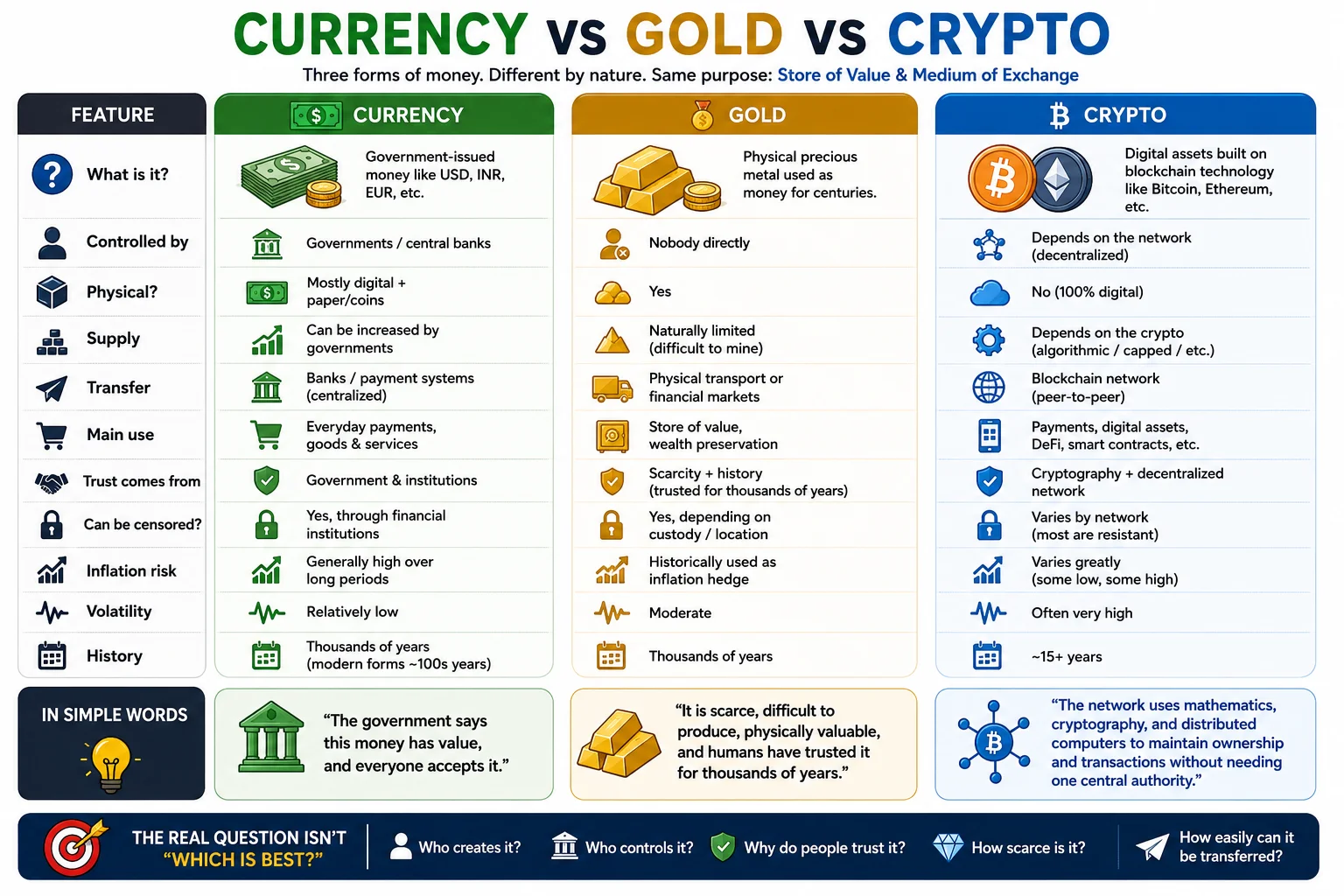
To evaluate whether crypto is 'real money,' it helps to use the standard economic definition: money needs to function as a store of value (holds purchasing power over time), a medium of exchange (widely accepted for transactions), and a unit of account (a common measure for pricing things). Historically, money evolved from barter to commodity money (gold, silver) to fiat currency — government-issued money backed by law and trust in the issuing state rather than a physical commodity.
Fiat systems are managed by central banks through monetary policy: adjusting interest rates and money supply to influence inflation, employment, and growth. Inflation erodes purchasing power over time; central banks in most developed economies target roughly 2% annual inflation as a stability goal, though actual rates vary widely by country and period. Currency debasement — expanding the money supply faster than the economy grows — is the core critique monetary economists and crypto advocates both point to, for different reasons.
Bitcoin's pitch as 'digital gold' rests on scarcity: a fixed, algorithmically enforced supply cap that no central authority can change unilaterally. Whether that makes it a good store of value is genuinely disputed — gold has thousands of years of monetary history and far lower volatility; Bitcoin has roughly a decade and a half and price swings of 50%+ are common. As a medium of exchange, Bitcoin's transaction throughput and price volatility remain real obstacles to everyday use, which is part of why stablecoins (Chapter 10) exist.
Data snapshot
Takeaway
Whether Bitcoin is 'money' depends on which function you're testing — it makes a stronger case as a store of value than as a day-to-day medium of exchange.
Blockchain — The Core Technology
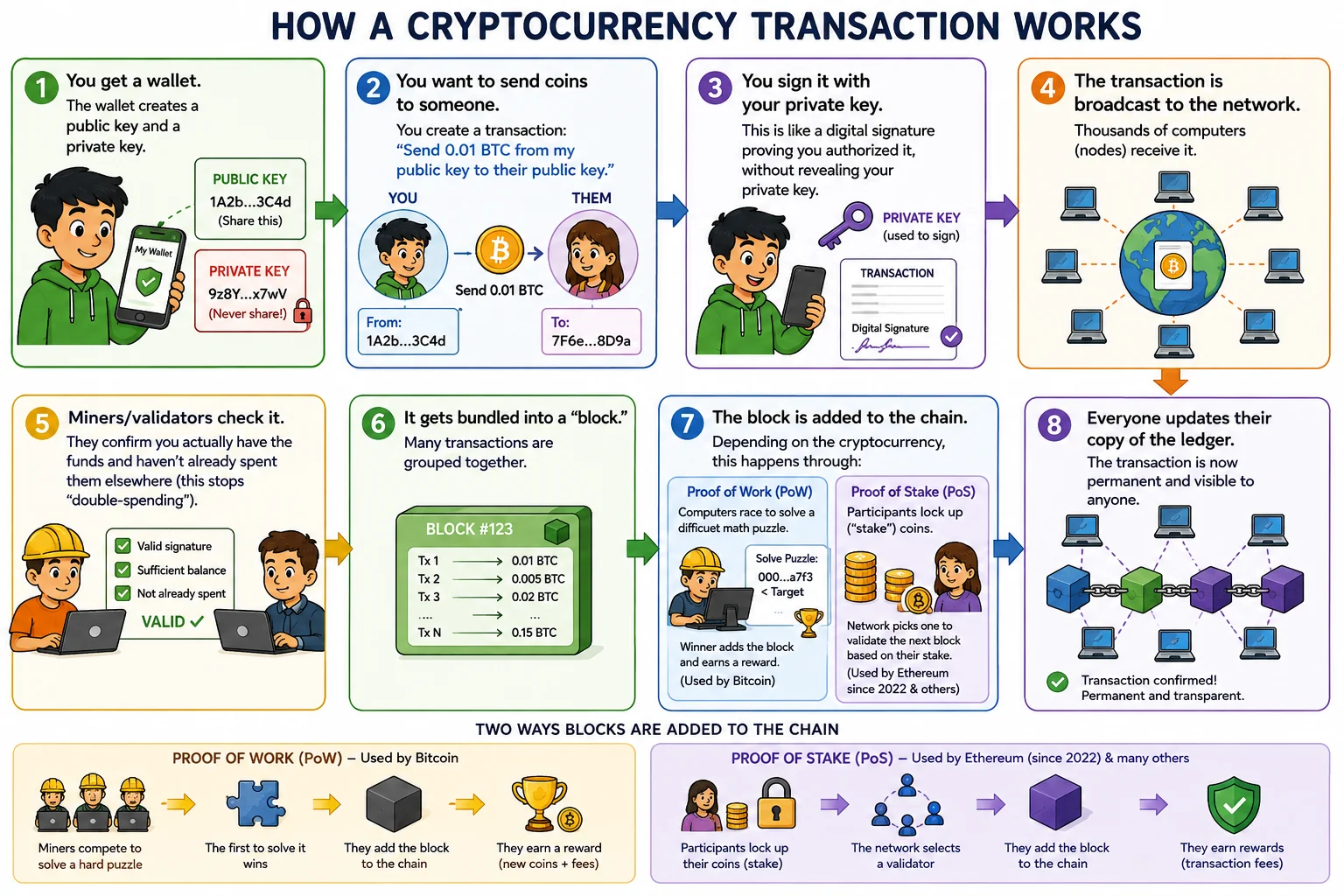
A blockchain is a chain of blocks, where each block bundles a batch of transactions and a cryptographic hash of the previous block. That hash-linking is what makes the chain tamper-evident: changing any past transaction changes its block's hash, which breaks every subsequent link, which every node on the network would immediately notice.
Each transaction is signed with a private key and broadcast to the network, where nodes — computers running the blockchain's software — validate it against the protocol's rules (sufficient balance, valid signature, no double-spend) before it's included in a block. Miners (in Proof of Work systems) or validators (in Proof of Stake systems) compete or are selected to propose the next block; consensus is the mechanism by which the network agrees on which version of the ledger is canonical when multiple valid blocks might exist.
'Immutable' is a useful but imprecise word. A blockchain isn't literally unchangeable — it's economically and computationally expensive to rewrite, and that expense grows with every confirmation (additional block built on top). A transaction with one confirmation is far less final than one with sixty; this is why exchanges wait for multiple confirmations before crediting a large deposit. Anyone can inspect this entire process on a blockchain explorer, a public search engine for a chain's transactions, addresses, and blocks — one of the more genuinely novel transparency properties of the technology.
Data snapshot
Takeaway
Blockchain security isn't about being unbreakable — it's about making tampering so expensive and detectable that it's irrational to attempt.
Cryptography
Two cryptographic tools do almost all the work in a blockchain. The first is the hash function (Bitcoin uses SHA-256): a one-way mathematical function that turns any input into a fixed-length, unique-looking string. Change one character of the input and the output is completely different — this is what makes tampering detectable and what miners are effectively racing to find valid outputs for.
The second is public-key cryptography. You have a private key (a secret number — never share it), which mathematically generates a public key, which in turn generates your public wallet address. You sign transactions with your private key; anyone can verify that signature using your public key, without ever seeing the private key itself. This is what makes 'proving ownership without revealing the secret' possible.
A seed phrase (typically 12 or 24 words) is a human-readable backup of the master private key that can regenerate an entire wallet's keys. It is, functionally, the single point of failure in most self-custody setups: whoever has the seed phrase controls the funds, permanently and irreversibly, with no password-reset option. Quantum computing is a genuine long-term concern for the underlying cryptography — theoretically, sufficiently powerful quantum computers could break current elliptic-curve signatures — but practical, cryptographically-relevant quantum computers do not yet exist, and the field is actively developing quantum-resistant alternatives well ahead of that risk materializing.
Data snapshot
Takeaway
In self-custody crypto, the seed phrase is the entire security model — there's no customer support line to call if it's lost or stolen.
Bitcoin
Bitcoin's monetary policy is its defining feature: a hard cap of 21 million coins, enforced by code rather than a central bank. New bitcoin enters circulation as a block reward paid to the miner who successfully mines each block; that reward halves roughly every four years (every 210,000 blocks) in an event called 'the halving.' This is a deliberately engineered disinflation schedule — the last bitcoin is projected to be mined around the year 2140.
Bitcoin uses Proof of Work: miners compete to solve a computationally expensive puzzle, and the winner proposes the next block in exchange for the block reward plus transaction fees. This is expensive by design — the cost of mining is what makes attacking the network (rewriting history) economically irrational. The network's total computing power is measured as hash rate; mining difficulty automatically adjusts roughly every two weeks to keep block times near ten minutes regardless of how much hardware joins or leaves the network.
Bitcoin uses the UTXO (Unspent Transaction Output) model rather than an account-balance model — think of it like paying with cash and receiving change, rather than a bank ledger tracking one running balance. This makes certain kinds of privacy and auditing easier but complicates some smart-contract use cases, which is part of why Bitcoin's scripting is deliberately limited compared to Ethereum's. The Lightning Network is Bitcoin's main scaling answer: a second layer of payment channels that lets participants transact near-instantly and near-free, settling to the base chain only when channels open or close. Institutional adoption accelerated sharply after the approval of US spot Bitcoin ETFs in January 2024, giving traditional investors regulated exposure without self-custody.
Data snapshot
Takeaway
Bitcoin optimizes for one thing above all else — predictable, tamper-resistant scarcity — and accepts slower speed and higher energy cost as the price of that security.
Other Major Cryptocurrencies
No two major chains are solving the identical problem, even when they compete for the same users. Ethereum prioritizes programmability — smart contracts and a general-purpose virtual machine — over raw settlement simplicity. Solana prioritizes raw throughput and low fees using Proof of History combined with Proof of Stake, trading some decentralization and historically some network reliability for speed. BNB Chain is closely tied to the Binance exchange ecosystem, trading some decentralization for developer convenience and liquidity. XRP (Ripple) targets cross-border settlement for financial institutions, with a consensus mechanism and origin story distinct from mined or staked networks.
Cardano emphasizes peer-reviewed academic research and a deliberately slower, formally verified development process. Avalanche and Polkadot both pursue interoperability between multiple chains through different architectures — subnets and parachains, respectively. Chainlink isn't a payments chain at all; it's an oracle network that feeds real-world data (prices, events) to smart contracts on other blockchains, solving a problem every DeFi protocol depends on. Dogecoin and Litecoin represent an older generation: Dogecoin began as a joke fork of Litecoin and now persists largely on community and celebrity attention rather than distinct technical merit.
When evaluating any of these, the same questions apply: What specific problem does this solve that alternatives don't? Who actually uses it, and for what? Is its security and decentralization real or asserted? And critically — covered fully in Chapter 15 — does using the network actually create value that flows to token holders, or is the token separable from the network's success?
Data snapshot
Takeaway
Comparing chains as 'Bitcoin killers' misses the point — most are optimizing for different tradeoffs, not competing on the same axis.
Ethereum & Smart Contracts
Ethereum, proposed by Vitalik Buterin in 2013 and launched in 2015, generalized Bitcoin's idea: instead of a ledger that only tracks coin balances, build a ledger that can run arbitrary code. A smart contract is a program deployed on-chain that executes exactly as written, with its logic and (usually) its state publicly visible and enforced by the network rather than a company's servers.
The Ethereum Virtual Machine (EVM) is the runtime that executes this code identically across every node. Gas is the fee mechanism that prices computation — every operation costs a small amount of gas, paid in ETH, which both compensates the network and prevents infinite loops or spam from clogging the chain. Gas fees spike when demand for block space exceeds supply, which is the direct cause of Ethereum's periodic high-fee periods during popular NFT mints or DeFi activity surges.
Ethereum shifted from Proof of Work to Proof of Stake in September 2022 ("the Merge"), replacing miners with validators who lock up (stake) 32 ETH as collateral that can be destroyed ("slashed") for provable misbehavior, cutting the network's energy use by over 99%. Because Ethereum's base layer can't process unlimited transactions cheaply, most everyday activity has moved to Layer 2 rollups — Optimistic rollups (which assume transactions are valid unless challenged) and ZK-rollups (which use cryptographic proofs to verify batches of transactions) — that execute transactions off the main chain and post compressed proofs or data back to it for security.
Data snapshot
Takeaway
Ethereum's core bet is that programmability is worth more than raw simplicity — and that scaling belongs on layers built on top, not the base chain itself.
Crypto Wallets
A wallet doesn't actually 'store' crypto — the assets live on the blockchain; a wallet stores the keys that prove and control ownership. The most consequential distinction is custodial versus non-custodial: a custodial wallet (most exchange accounts) means a third party holds your keys and you trust them to honor withdrawals; a non-custodial wallet means you hold the keys yourself, with all the responsibility and irreversibility that implies. The community shorthand — 'not your keys, not your coins' — captures the tradeoff, but so does its inverse: your keys, your problem if you lose them or get phished.
Hot wallets stay connected to the internet (mobile apps, browser extensions) for convenience; cold wallets stay offline. Hardware wallets are purpose-built devices that keep private keys isolated from an internet-connected computer even when signing a transaction, making them the standard recommendation for meaningful holdings — though, as Chapter 19's case studies show, hardware isn't automatically infallible.
Multi-signature wallets require multiple keys (e.g., 2-of-3) to authorize a transaction, spreading trust across multiple devices or people rather than a single point of failure — commonly used by exchanges, DAOs, and security-conscious individuals. Wallet phishing and 'address poisoning' (sending a near-identical fake address to a target's transaction history hoping they copy the wrong one from memory) are now more common attack vectors than breaking the cryptography itself — the weak point has moved from the math to the human.
Data snapshot
Takeaway
Wallet security is less about the technology and more about operational discipline — most losses trace back to human error, not broken cryptography.
Crypto Exchanges
Centralized exchanges (CEXs) — Binance, Coinbase, and similar platforms — operate like traditional brokerages: they custody user funds, match buyers and sellers through an internal order book, and offer convenience (fiat on-ramps, customer support, simpler interfaces) at the cost of trusting the exchange's solvency and security. Decentralized exchanges (DEXs) — Uniswap and similar protocols — instead use smart contracts and liquidity pools to let users trade directly from their own wallets without ever handing custody to an intermediary.
Order books work by matching market orders (execute immediately at the best available price) against limit orders (execute only at a specified price or better); the gap between the best buy and sell price is the spread, and exchanges typically charge lower 'maker' fees to those who add liquidity to the book versus higher 'taker' fees to those who remove it.
Proof of reserves — an exchange cryptographically demonstrating it holds the assets it claims to hold on behalf of users — became a major industry focus after FTX's collapse revealed a platform had been lending out customer deposits without disclosure. It's a meaningful transparency tool but an imperfect one: it typically shows assets at a point in time, not liabilities in full, and doesn't by itself prove an exchange isn't borrowing reserves briefly to pass an audit.
Data snapshot
Takeaway
The CEX-vs-DEX choice is really a convenience-versus-custody tradeoff, and the FTX collapse is the clearest case study in what that tradeoff can cost.
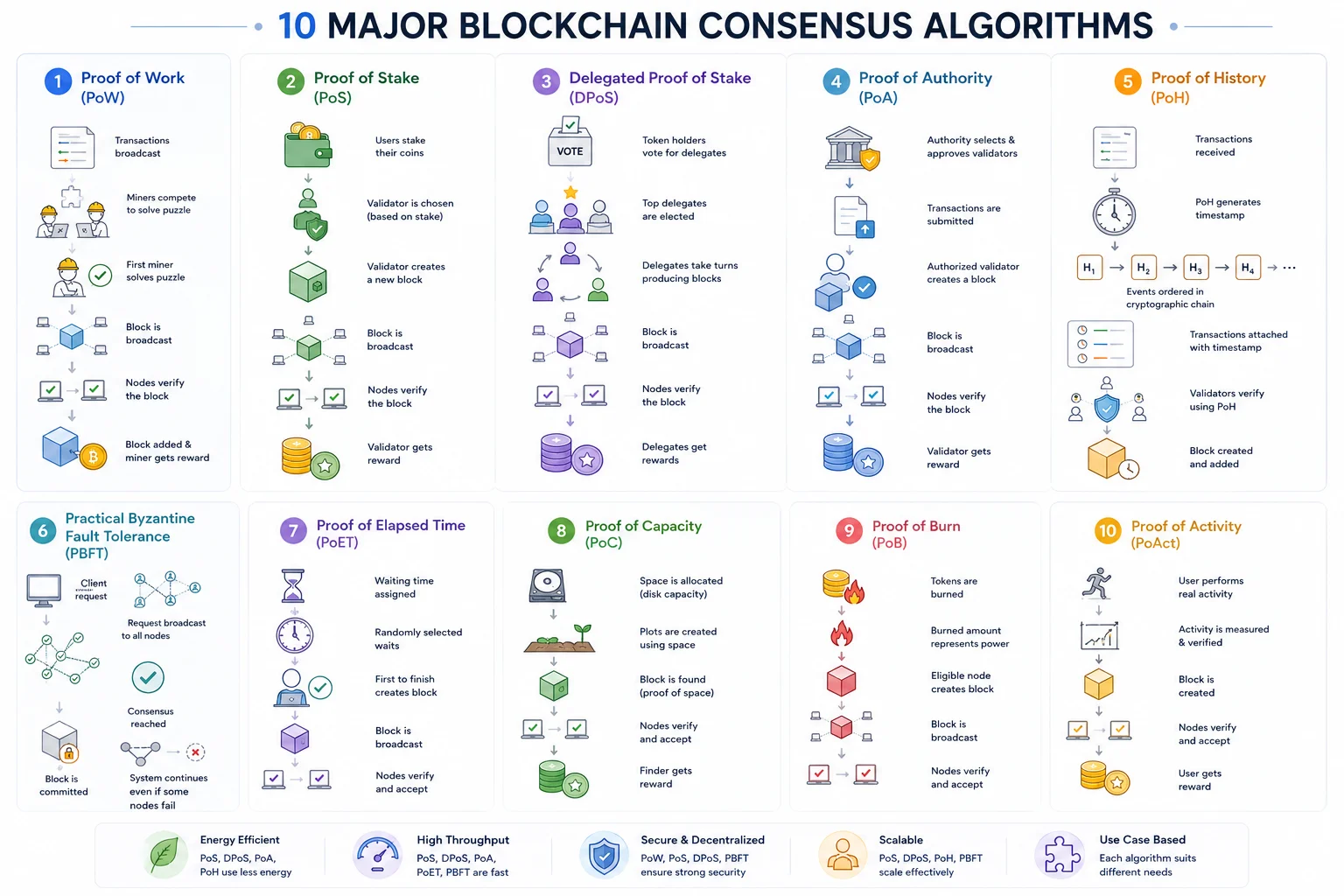
Top 5 Consensus Mechanisms Compared
An in-depth analysis of the core protocol architectures that govern transaction validation, network security, and block creation across modern blockchains.
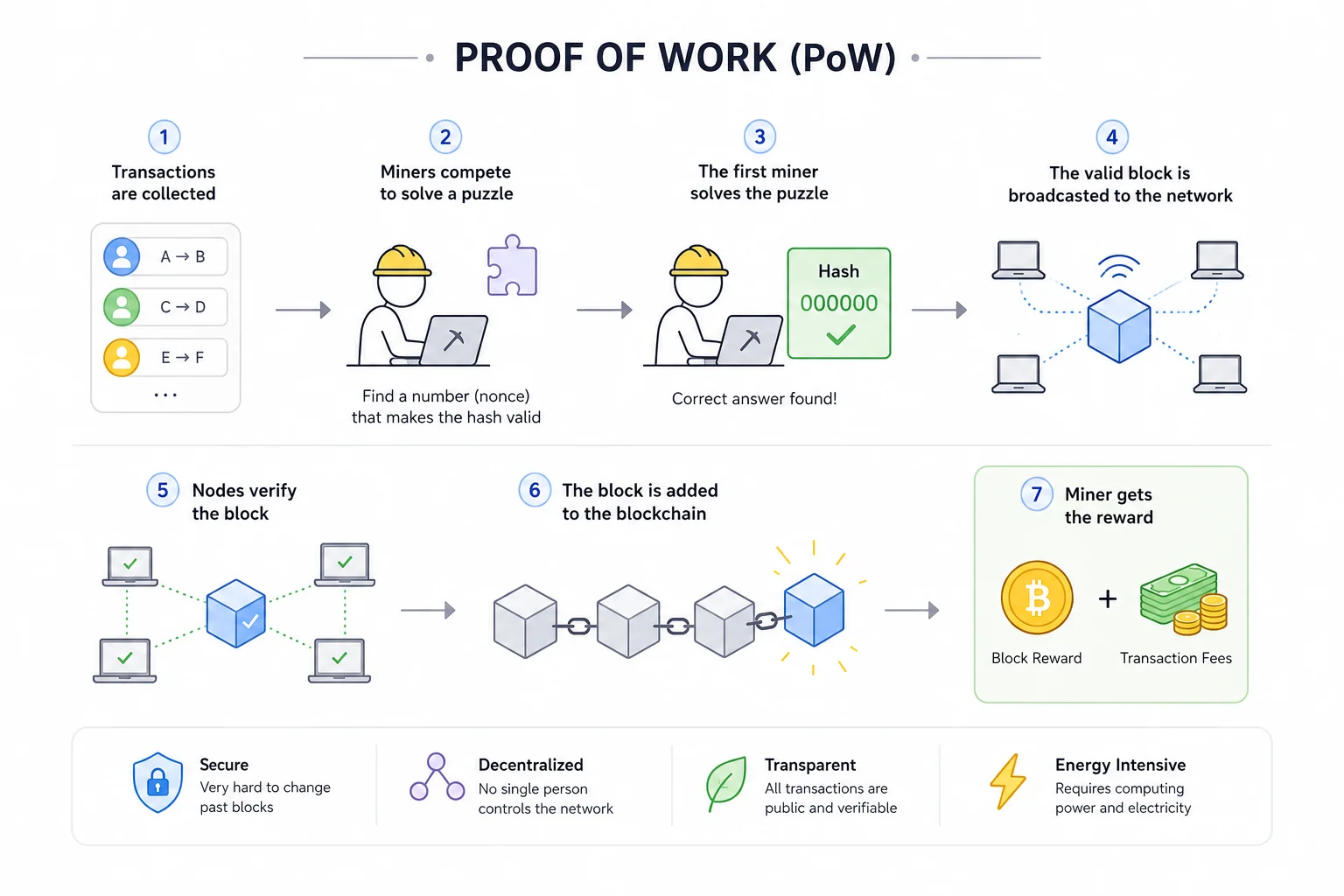
Definition: A consensus method where network participants ("miners") compete to solve a complex mathematical puzzle using computing power. The first to solve it gets to add the next block to the blockchain and receives a reward.
- Longest track record — the most battle-tested and secure model in the industry
- Highly decentralized when enough independent miners participate
- Extremely resistant to tampering once a block is confirmed
- Consumes very large amounts of electricity
- Slower transaction speeds compared to newer methods
- Mining tends to concentrate around large, well-funded operations over time
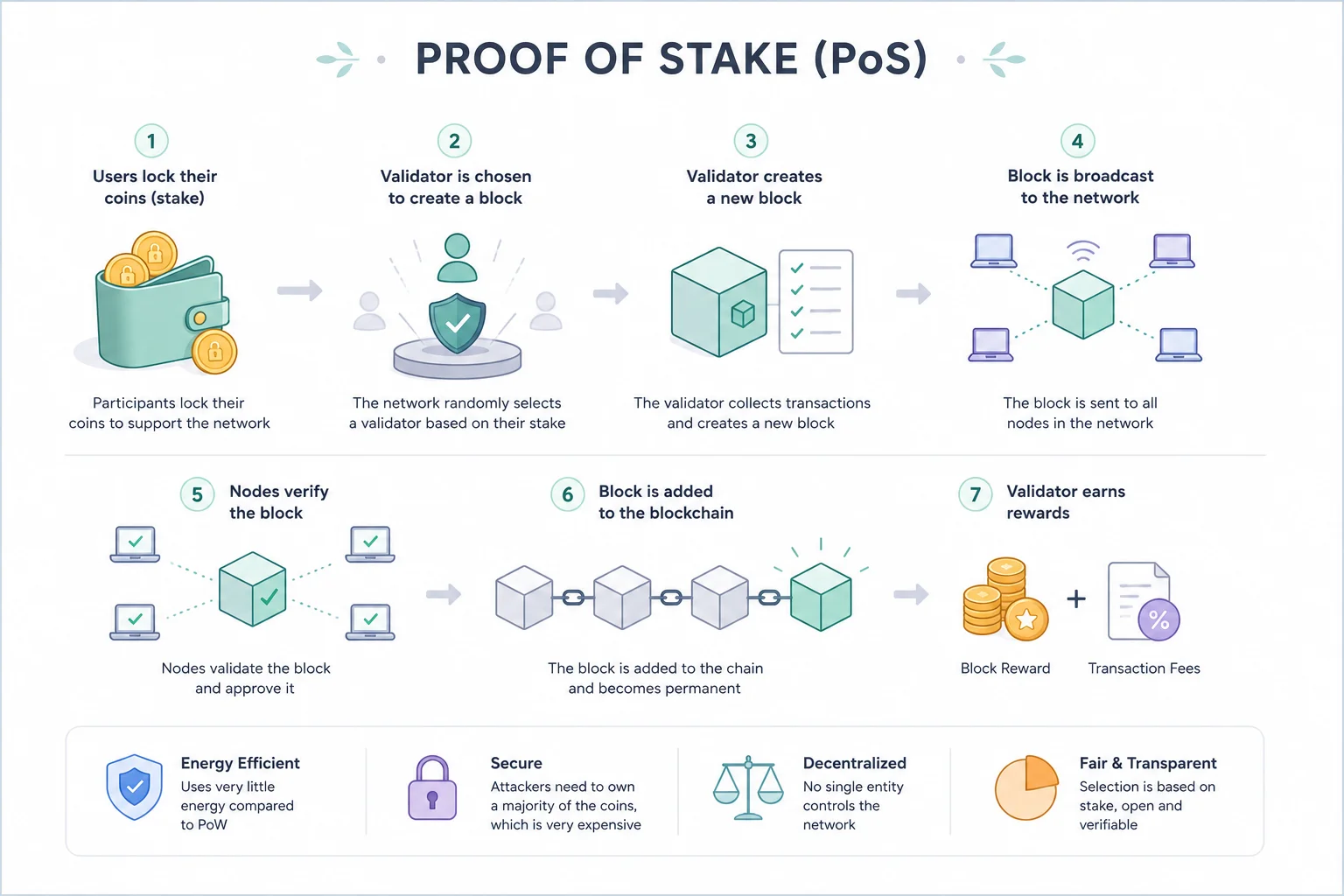
Definition: Validators lock up ("stake") their own coins as collateral. The network selects a validator to approve the next block based on the size of their stake, replacing computing competition with financial commitment.
- Uses a fraction of the energy compared to Proof of Work
- Lower barrier to participation — no specialized mining hardware needed
- Faster block confirmation times
- Can favor wealthier participants who hold larger stakes
- Newer and less time-tested than Proof of Work
- Potential for centralization if stake concentrates among a few large holders
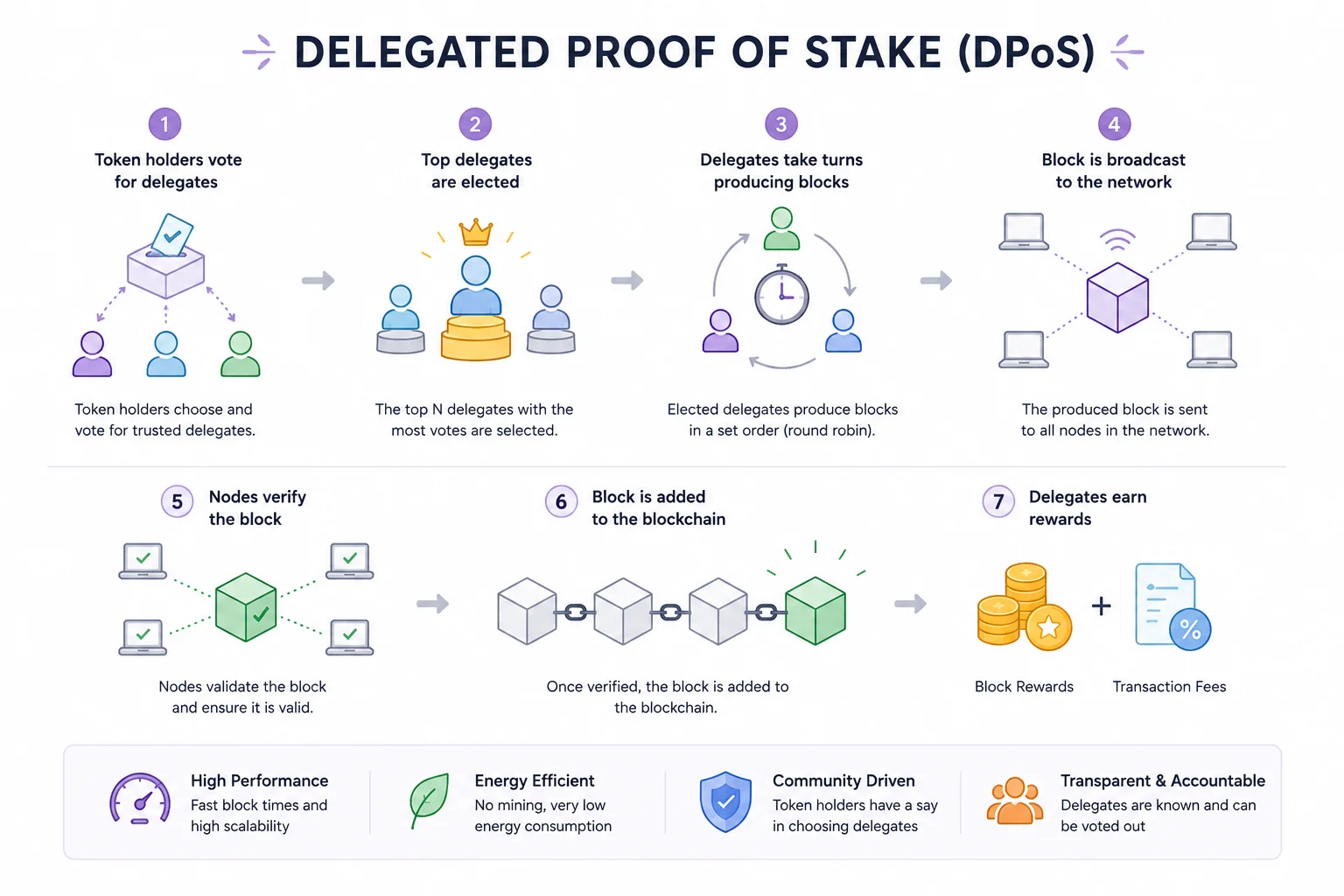
Definition: Coin holders vote to elect a limited number of trusted delegates, who are then responsible for validating transactions and producing blocks on the network's behalf.
- Very fast transaction processing
- Energy-efficient
- Democratic in structure — delegates can be voted out for poor performance
- Less decentralized — power concentrates among a small elected group
- Voting participation is often low, reducing real democratic control
- Risk of delegate collusion or cartel-like behavior
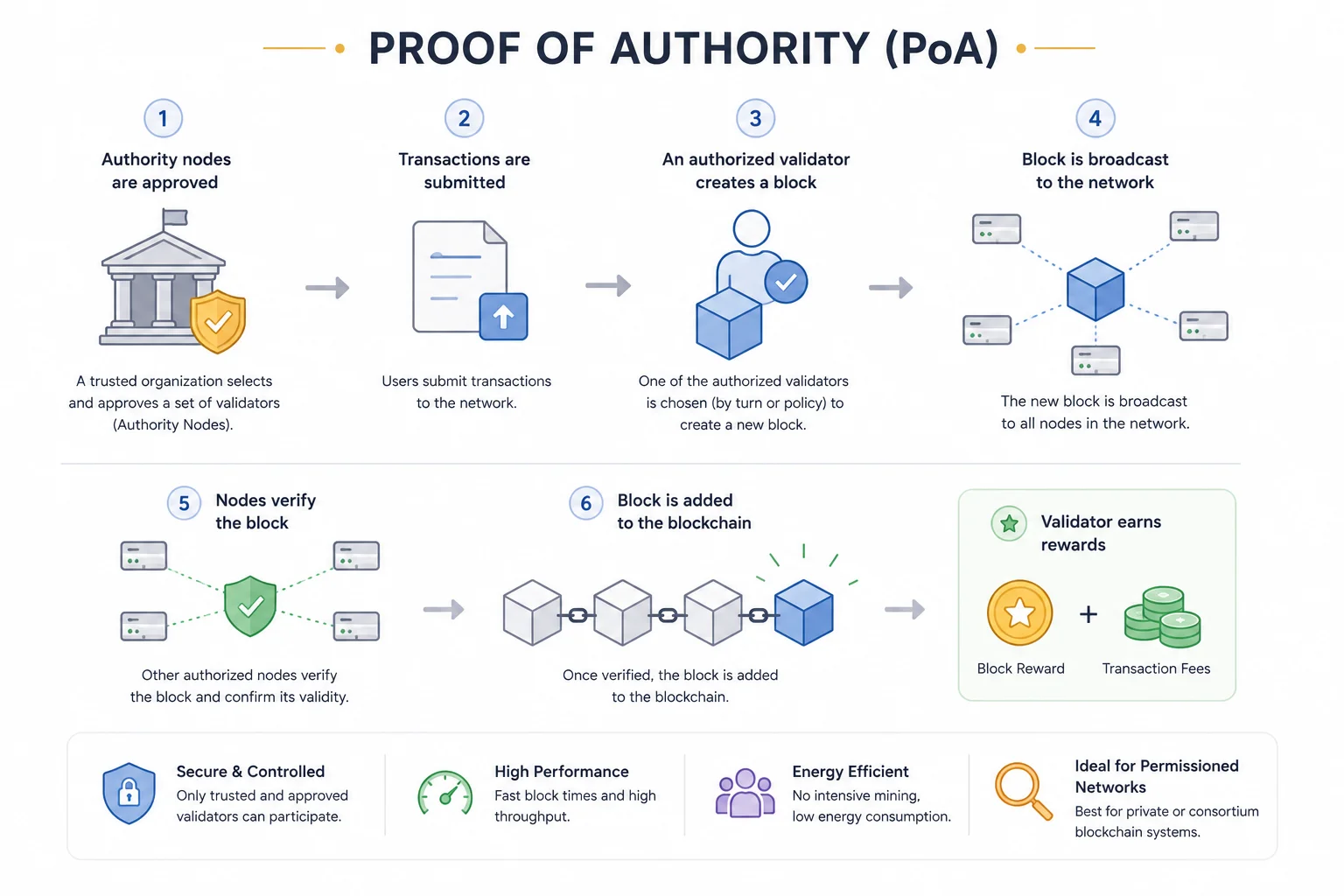
Definition: A fixed set of pre-approved, identity-verified validators are solely responsible for approving transactions and creating blocks, replacing open competition with a trusted, known group.
- Very high transaction speed and efficiency
- Low computational and energy requirements
- Well suited for enterprise or permissioned use cases where accountability matters
- Sacrifices decentralization — control rests with a small, known group
- Requires trusting the integrity of the approved validators
- Not well suited for fully public, trustless applications
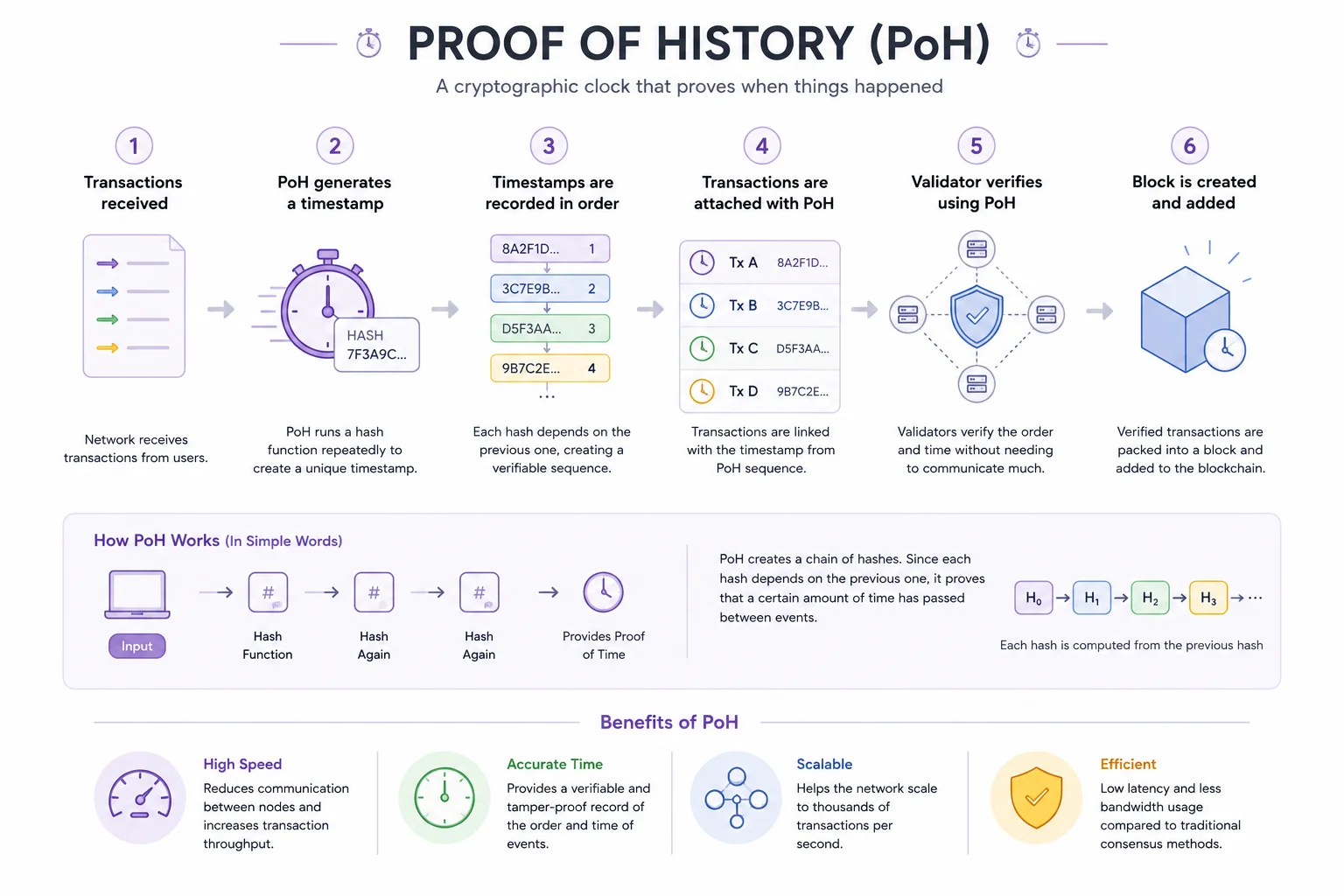
Definition: A method that creates a verifiable, cryptographic timestamp for each event before consensus occurs, allowing the network to agree on the order of transactions quickly. It is typically combined with Proof of Stake for validation.
- Enables very high transaction throughput and speed
- Reduces the time validators spend agreeing on transaction order
- Well suited for high-performance applications
- Newer and less proven at scale than PoW or PoS
- Relies on high-performance hardware for validators, raising entry costs
- Has experienced network outages/reliability issues in real-world use
Key Takeaway
Each algorithm reflects a different trade-off between decentralization, security, speed, and energy efficiency. Proof of Work prioritizes security and independence; Proof of Stake balances security with efficiency; Delegated Proof of Stake and Proof of Authority trade some decentralization for speed and simplicity; Proof of History pushes for maximum transaction throughput. No single model is universally superior — the right choice depends on a network's specific priorities.
Stablecoins
Stablecoins exist to solve crypto's volatility problem: a token pegged to a stable reference asset, almost always the US dollar, that lets people transact and hold value in the crypto ecosystem without constant price risk. Below is the comprehensive breakdown of the four primary stablecoin categories powering the digital dollar system.
A. Fiat-Backed (Reserve-Backed) Stablecoins
Examples: USDT (Tether), USDC (Circle), PYUSD (PayPal), RLUSD (Ripple)
How it works: For every 1 token issued, the company holds $1 (or an equivalent asset) in reserve — typically cash, cash equivalents, and short-term U.S. government debt (Treasury bills).
- You give the company $1 → they mint (create) 1 token for you.
- You give back 1 token → they burn (destroy) it and send you $1.
- This "arbitrage" process (see box below) is what keeps the price near $1 on public markets.
This is by far the dominant model — as of mid-2026, fiat-backed coins like USDT and USDC together make up roughly 80%+ of the entire stablecoin market.
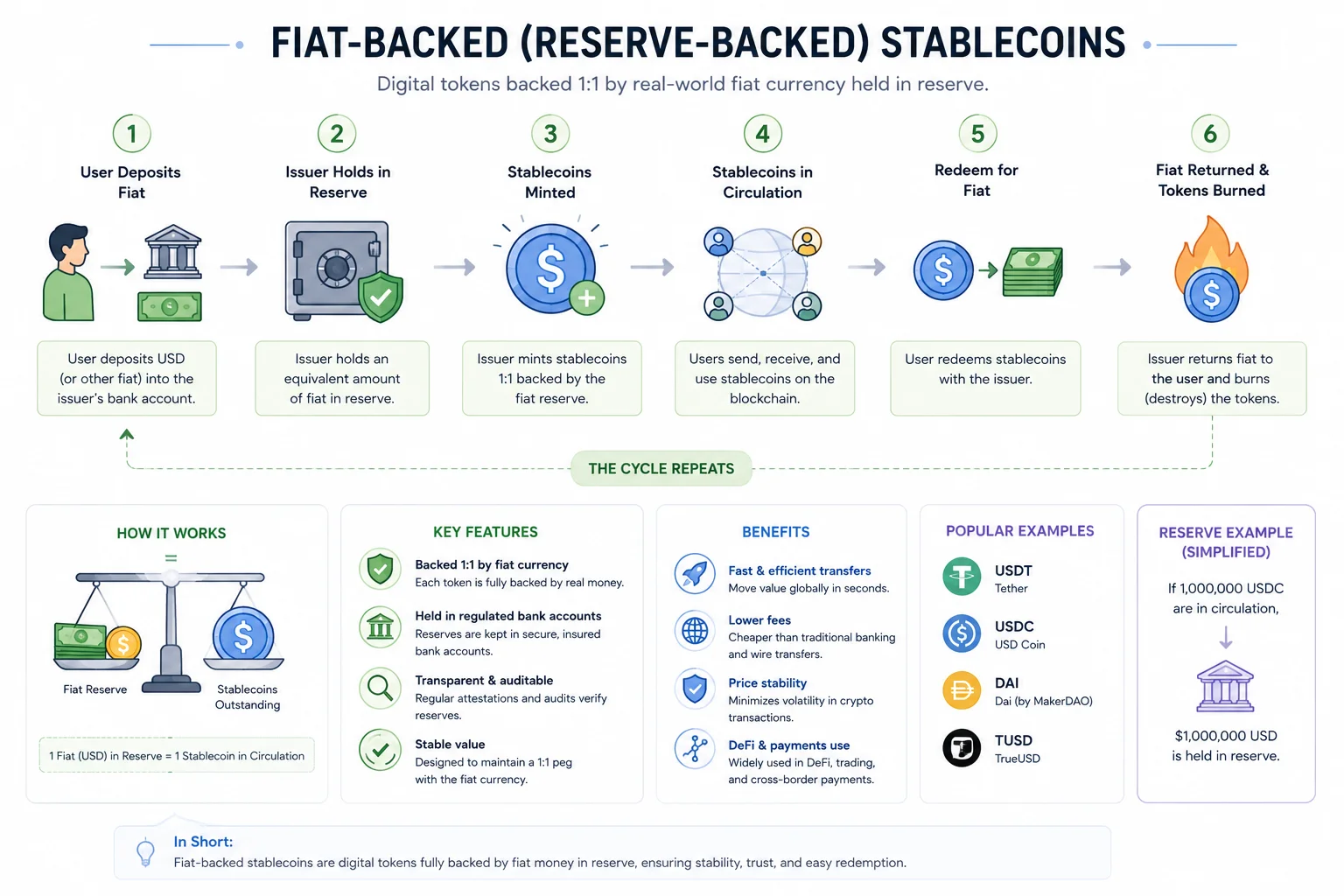
If a stablecoin ever trades for $0.98 on an exchange, a trader can buy it cheap, redeem it with the issuer for a full $1, and pocket the $0.02 difference. This buying pressure pushes the price back toward $1. If it trades at $1.02, traders do the opposite — mint new tokens for $1 and sell them for $1.02. This constant buying-and-selling pressure is the invisible hand that holds the peg, as long as redemption actually works and reserves are real.
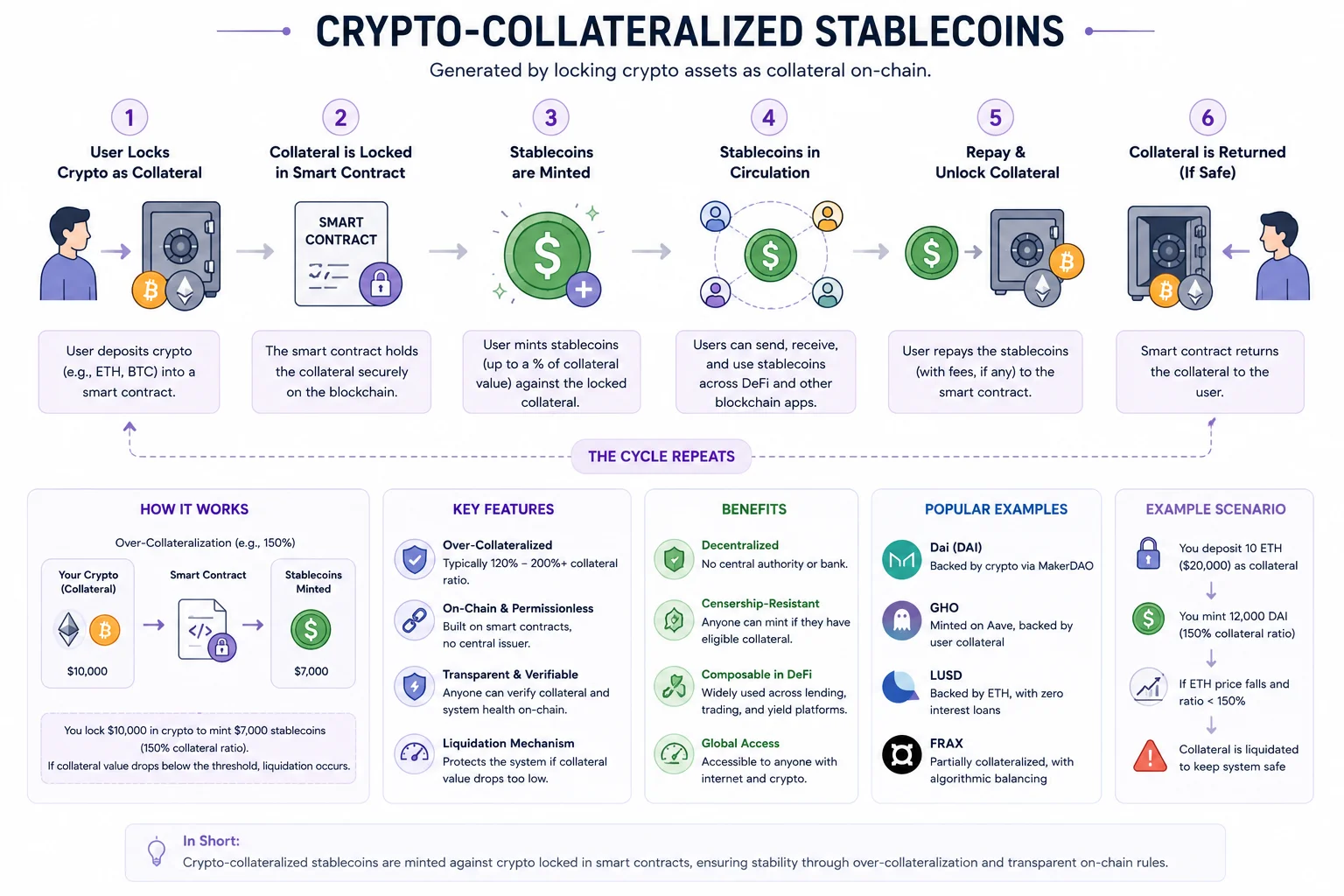
B. Crypto-Collateralized Stablecoins
Example: DAI (Sky, formerly MakerDAO)
How it works: Instead of dollars in a bank, this design locks up other cryptocurrencies (like Ethereum) as collateral in a smart contract (self-executing code on the blockchain). Crucially, it's usually overcollateralized — you might have to lock up $150 worth of crypto to borrow $100 worth of the stablecoin. This buffer protects the peg even if the collateral's price drops somewhat.
This design is more decentralized (no single company holding your money in a bank account) but more complex, and it's exposed to smart contract bugs and sudden crypto crashes.
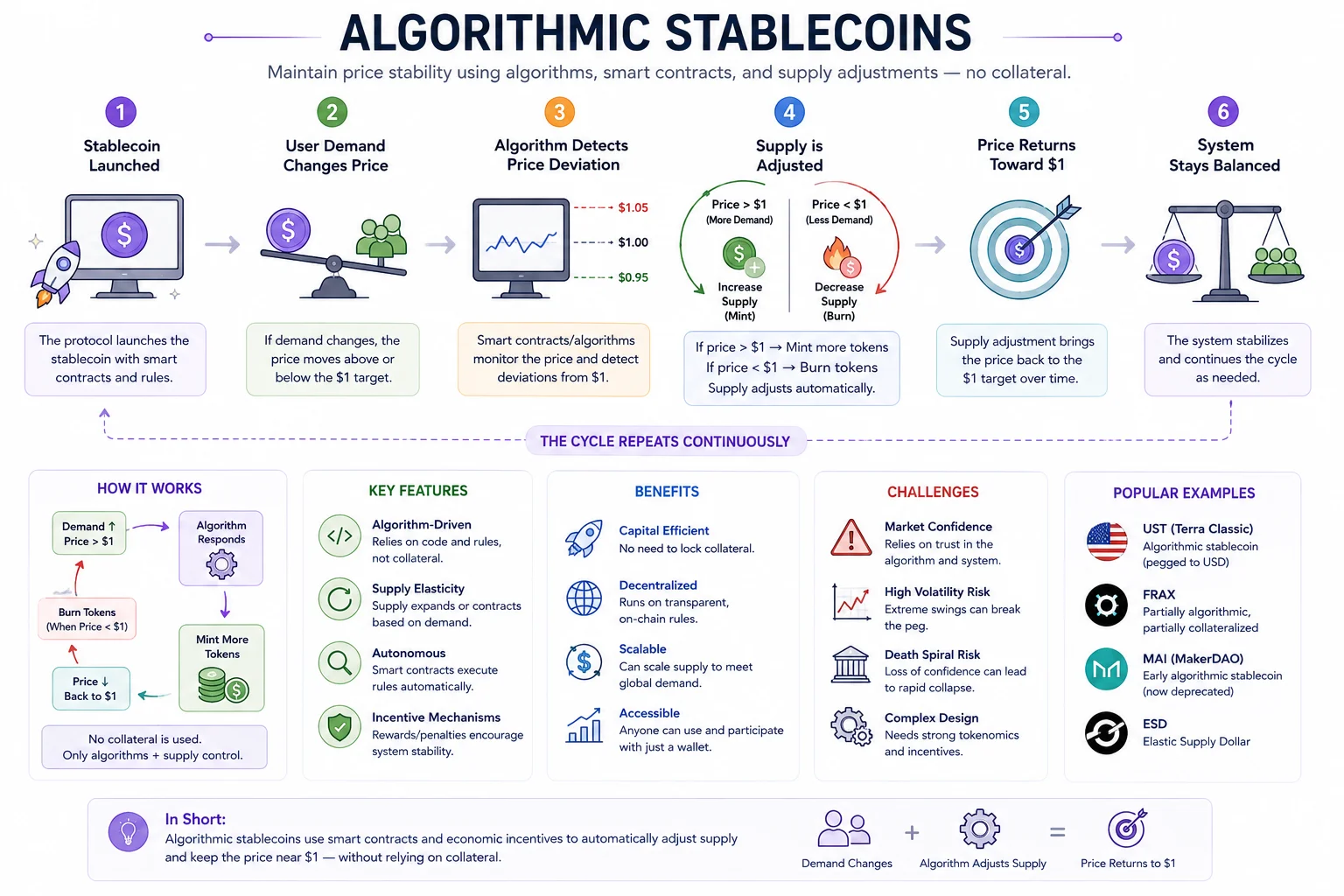
C. Algorithmic Stablecoins
Example (collapsed): TerraUSD (UST)
How it works: These try to hold the peg using code and financial incentives rather than real collateral — for example, letting users trade the stablecoin for a "sister" token whose supply adjusts to push the price back to $1. This design has no hard asset floor.
Why this matters: This is widely regarded as the riskiest category. It failed spectacularly with Terra/UST in 2022, and several smaller algorithmic-style stablecoins have depegged sharply in 2026 as well. Most experts today advise extreme caution with any stablecoin that isn't backed by real, verifiable assets.
D. Yield-Bearing / Synthetic Stablecoins
Example: USDe (Ethena)
How it works: A newer category that generates its stability through a hedged trading strategy (holding an asset like Ethereum while shorting a matching futures position) rather than simple cash reserves. These can offer users a built-in yield but introduce new risks tied to derivatives markets and funding rates.
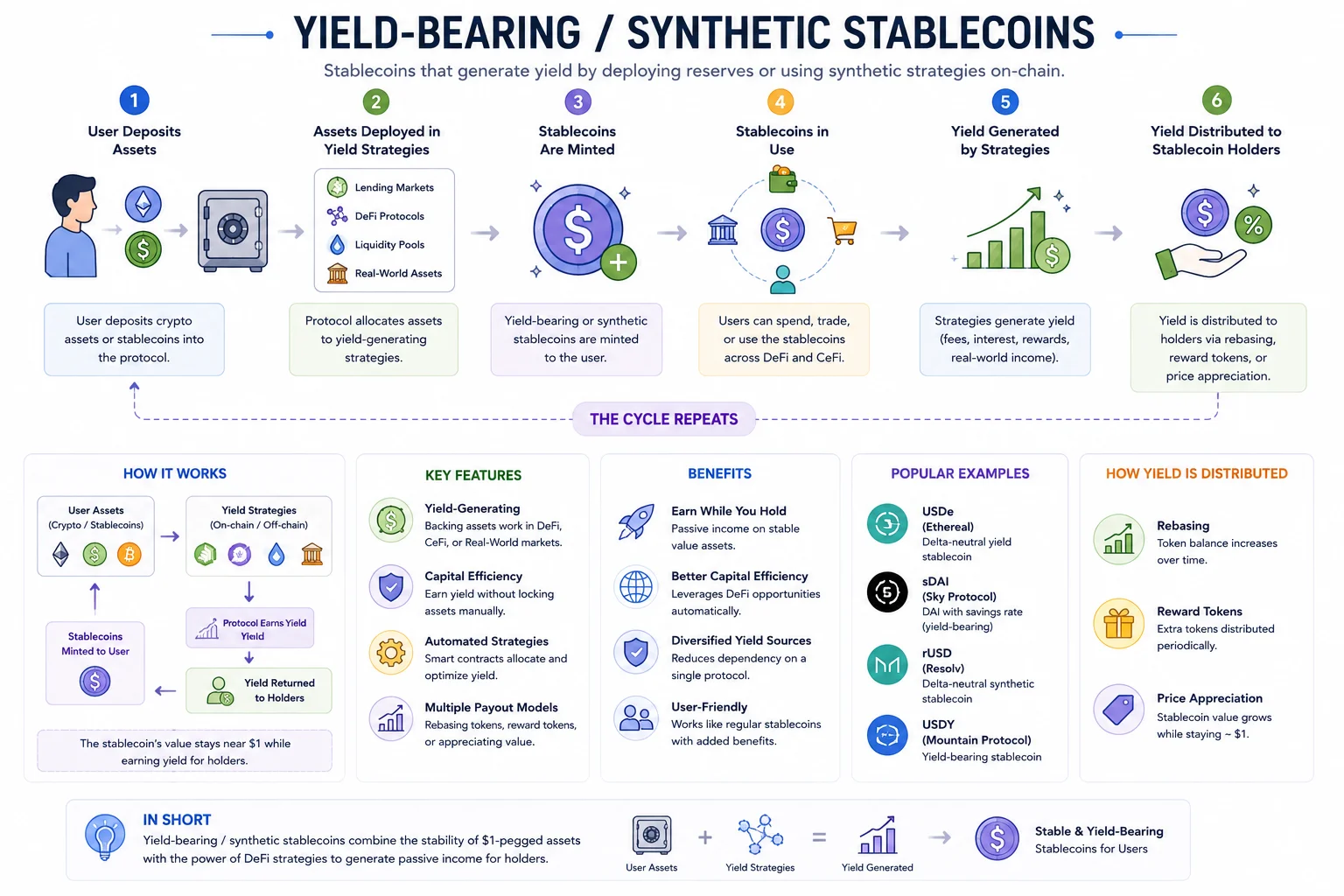
Data snapshot
Takeaway
Not all stablecoins are equally stable — the collateral model behind the peg matters more than the price chart during calm periods.
DeFi — Decentralized Finance
DeFi rebuilds financial services — trading, lending, borrowing, derivatives — as open smart contracts instead of institutions with account managers and branch offices. A decentralized exchange typically works via an Automated Market Maker (AMM): instead of an order book, users trade against a liquidity pool of two assets, with prices set algorithmically by the pool's ratio, and traders pay a fee that's distributed to whoever supplied that liquidity.
Lending and borrowing protocols (like Aave or Compound) let users deposit assets to earn yield, or borrow against deposited collateral without a credit check — the loan is enforced entirely by collateral ratios and automatic liquidation if that collateral's value falls too far. Flash loans are a DeFi-native invention with no traditional equivalent: uncollateralized loans that must be borrowed and repaid within a single transaction, useful for legitimate arbitrage but also, historically, a favorite tool for oracle-manipulation attacks (Chapter 30).
Yield farming and liquidity mining — chasing the best returns across pools and protocols, often subsidized by a project's own token emissions — drove much of DeFi's 2020-21 growth, but that yield is frequently a form of dilution rather than genuine profit: new tokens printed to pay depositors, whose long-term value depends entirely on whether the protocol generates real revenue to back them. DeFi's central risk, covered in depth in Chapter 19, is that 'no intermediary' also means 'no one to call' if a smart contract has a bug or an oracle gets manipulated.
Data snapshot
Takeaway
DeFi replaces institutional trust with code and collateral — which removes gatekeepers but also removes the safety nets those gatekeepers sometimes provided.
NFTs
A non-fungible token represents verifiable, unique ownership of a specific digital (or digitally-linked) asset on a blockchain — 'non-fungible' meaning each one is distinct, unlike an interchangeable Bitcoin or dollar. Ethereum's ERC-721 and ERC-1155 standards defined the technical format that let NFTs become interoperable across marketplaces and wallets.
The 2021 NFT boom was driven by digital art and profile-picture collections (Bored Ape Yacht Club, CryptoPunks), but the underlying pattern generalized to gaming items, event and membership access, and royalty mechanisms that let creators earn a percentage on secondary sales automatically — something traditional art and media markets have never natively supported. The subsequent crash — trading volumes falling more than 90% from 2021-22 peaks — reflected a familiar pattern: speculative demand and wash trading (parties trading with themselves to inflate apparent volume and value) inflated prices well beyond what genuine collector or utility demand supported.
Beyond speculation, real-world applications have persisted more quietly: ticketing systems that prevent counterfeit tickets, gaming assets that players can genuinely own and trade across games, and membership tokens that gate access to communities or events. The technology's usefulness for verifiable digital ownership is generally not disputed; whether any specific NFT is worth its price is a separate question the market answered brutally for most 2021-era collections.
Data snapshot
Takeaway
The NFT technology (verifiable unique ownership) and the NFT market (2021-era speculation) are two different things — one mostly survived, the other mostly didn't.
Web3
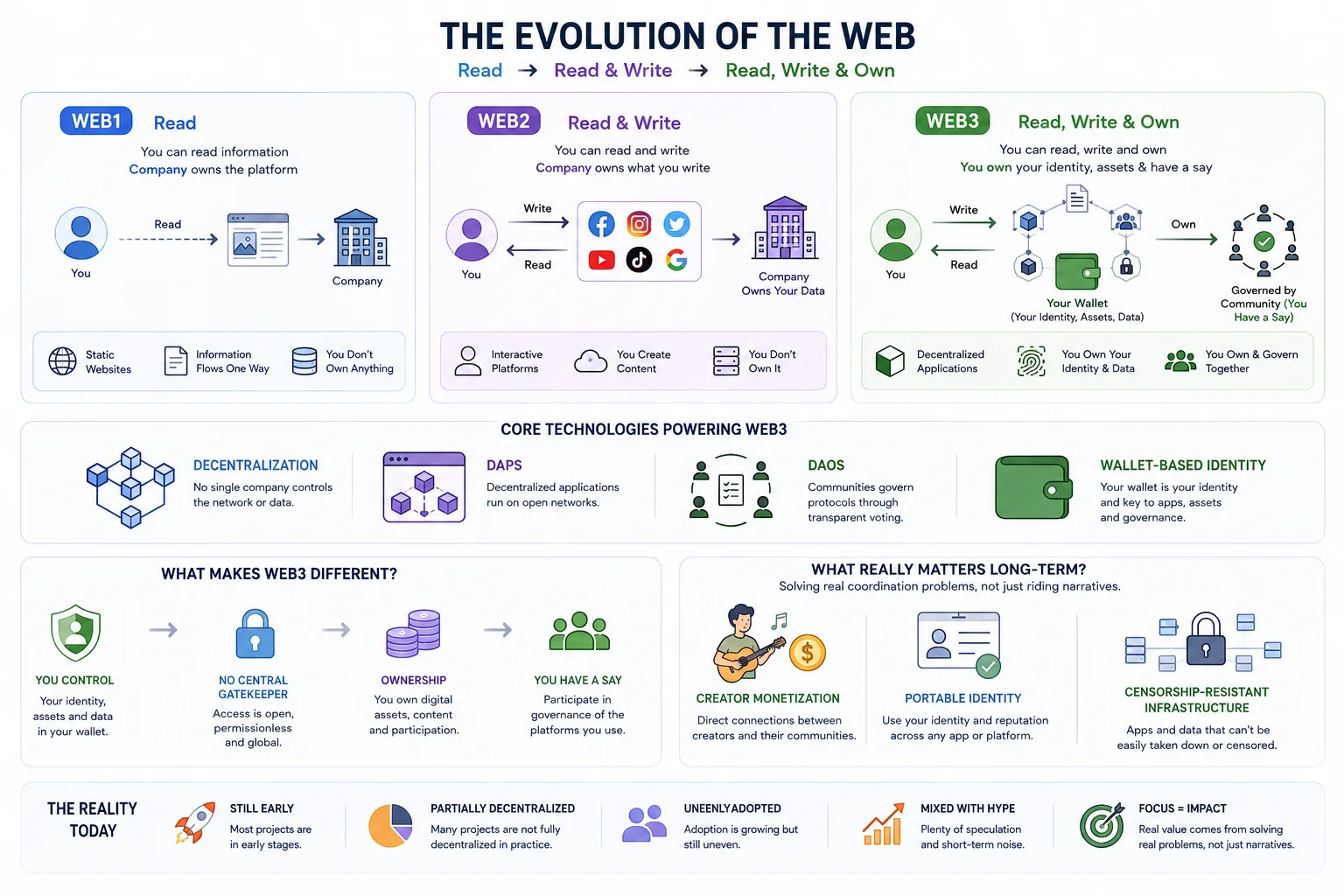
The Web1/Web2/Web3 framing is a narrative more than a rigorous technical category, but it's a useful one. Web1 (roughly 1990s-2000s) was mostly static, read-only pages. Web2 (2000s-present) introduced user-generated content and interactivity — but concentrated ownership and monetization in centralized platforms (social networks, app stores) that control the data and the rules. Web3 proposes user-owned data and assets, portable across applications via a wallet-based identity instead of a platform-issued account.
A dApp (decentralized application) is a frontend interface connected to smart-contract backend logic instead of a company's private server — the app's core rules live on-chain, visible and (often) unchangeable by the team that built it, though frontends and admin keys frequently remain centralized in practice, which is a real gap between the Web3 pitch and Web3 reality.
Web3 gaming and decentralized social media apply this pattern to specific industries: letting players own in-game assets that persist outside any single game, or letting users own their social graph and content independent of a platform that could ban or demonetize them. Adoption of both remains a small fraction of their Web2 equivalents as of 2026, constrained by cost, complexity, and — for gaming particularly — genuine skepticism from the existing gaming community about tokenized economies.
Data snapshot
Takeaway
Web3's promise is user ownership; its unresolved problem is that most 'decentralized' apps still have centralized points of control somewhere in the stack.
DAOs
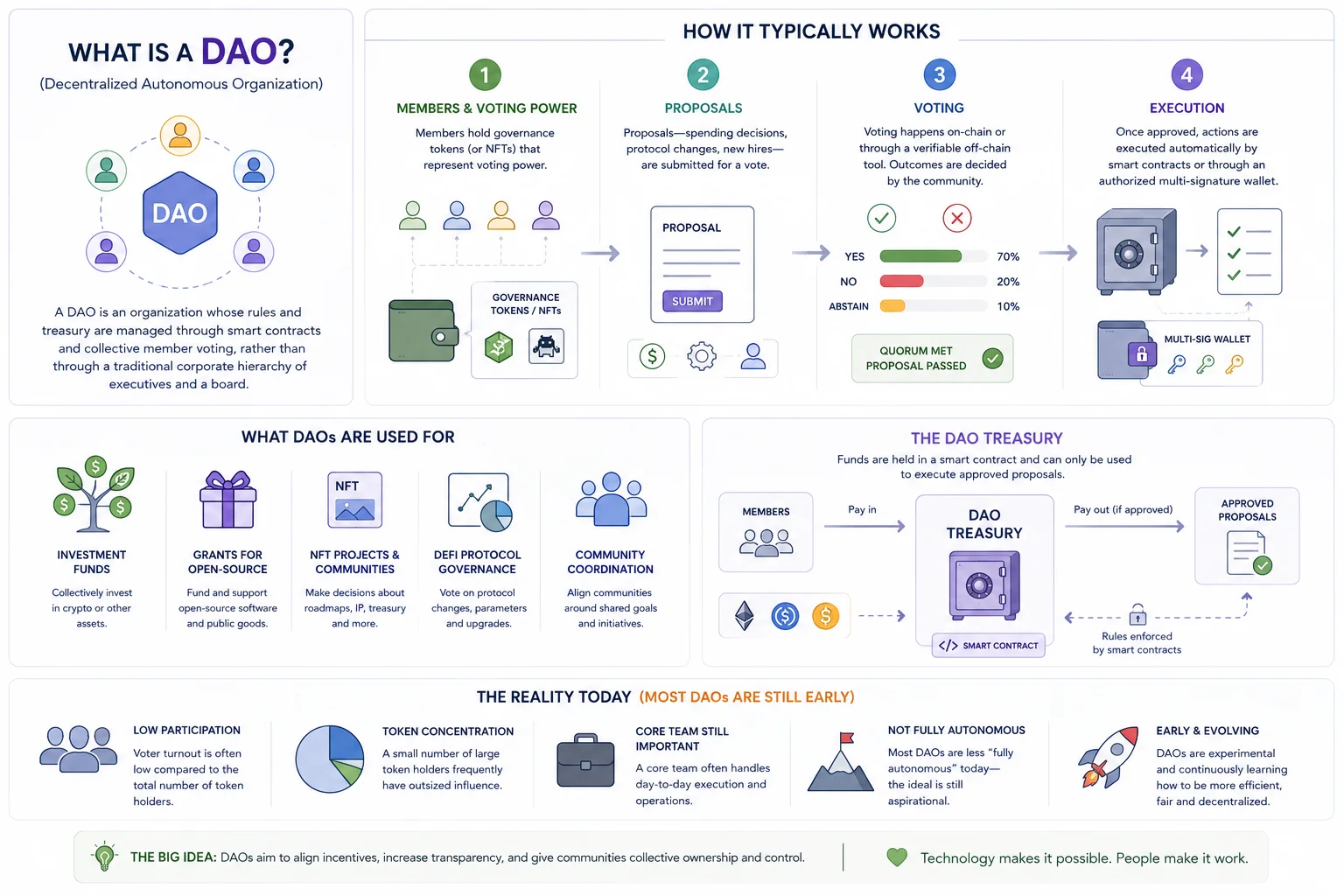
A Decentralized Autonomous Organization is a group coordinated through blockchain-based rules and token-holder voting instead of a traditional corporate hierarchy. Governance tokens grant voting rights, typically proportional to how many tokens a holder controls — a system that resembles shareholder voting more than one-person-one-vote democracy, with the same concentration risks that implies.
Proposal systems let members submit changes (protocol parameters, treasury spending, upgrades) that pass or fail by vote, with a DAO's treasury — often holding hundreds of millions of dollars in its own token and other assets — governed by that same voting process. In practice, voter turnout in most DAOs is low and voting power is often concentrated among founders, early investors, and large token holders, meaning many DAOs are less 'decentralized' in practice than in name.
The 2016 DAO hack — an attacker drained roughly $60 million in ETH through a smart-contract reentrancy bug, prompting Ethereum's community to controversially hard-fork the chain to reverse the theft — remains the foundational case study in both DAO security risk and the philosophical tension between 'code is law' immutability and pragmatic intervention when the code fails badly enough. Legal questions remain largely unresolved: most jurisdictions have no settled framework for DAO liability, meaning members can face uncertain legal exposure despite the organization having no traditional corporate structure.
Data snapshot
Takeaway
DAOs replace corporate hierarchy with token voting, but concentrated token ownership can quietly reproduce the same power structures they were meant to avoid.
Fundamental & On-Chain Analysis
The people building the project are often the single best predictor of long-term execution, because most crypto projects fail from poor execution, not bad ideas.
- Track record — Have the founders shipped working products before, in crypto or elsewhere? Past failures aren't automatically disqualifying, but a pattern of abandoned projects is a red flag.
- Transparency — Are the founders public and identifiable ("doxxed"), or fully anonymous? Anonymity isn't automatically a scam signal (Bitcoin's own creator is anonymous), but it does remove a layer of accountability, so it raises the bar for other due diligence.
- Team size and composition — Does the team have the actual engineering, security, and business development depth the roadmap requires, or is it a handful of people promising an enterprise-scale product?
- Advisors and backers — Credible advisors and investors can be a positive signal, but treat this cautiously — a logo on a website doesn't guarantee active involvement.
Ethereum's founder Vitalik Buterin is public and has a long, visible track record — a strong team signal compared to a project run by anonymous accounts with no history.
This is an assessment of what's actually being built under the hood, and whether it holds up technically.
- Is the core technical claim real and differentiated, or is it marketing language wrapped around an existing, common approach?
- Has the code been audited by a reputable third-party security firm, and were the findings addressed? Unaudited smart contracts holding significant user funds are a serious risk.
- Is the codebase open source and actively maintained (visible commit history, issue tracking), or closed and unverifiable?
- What are the technical tradeoffs the project has made — most blockchain designs trade off between decentralization, security, and scalability (often called the "blockchain trilemma"), and it's worth understanding which two a project prioritizes and why.
A DeFi protocol audited by a firm like CertiK before launch is lower-risk than one holding millions of dollars in user funds with no audit at all.
Technology is the engine; the product is whether anyone can actually use it to do something valuable.
- Does it work today, or is it primarily a whitepaper and roadmap promises? Live, functioning products carry far less execution risk than pre-launch concepts.
- Does it solve a real problem better than existing alternatives (crypto or non-crypto), or does it exist mainly to have a token?
- User experience — Is it usable by a non-technical person, or does it require deep crypto-native knowledge just to complete basic actions? Poor UX is one of the most common reasons genuinely good technology fails to find adoption.
Uniswap is a live product anyone can open and use today, unlike projects that raised funds in 2021 promising a "metaverse" that still hasn't shipped.
Real usage is the clearest evidence that a product has product-market fit, separate from speculative token trading.
- Daily/monthly active users or wallets — but be cautious, since this can be inflated by airdrop farming (users interacting purely to qualify for a future token reward, with no genuine interest in the product).
- User retention — do people keep coming back, or is usage a one-time spike tied to an incentive campaign?
- Growth trend — is the user base actually growing over multiple quarters, or was there one hype-driven spike followed by decline?
50,000 new wallets in a week sounds great, but if they only showed up for a token giveaway and never returned, that's not real usage.
An increasing number of crypto projects now generate measurable revenue, most commonly from transaction or protocol fees, and this has become a core part of fundamental analysis, especially for DeFi protocols.
- Protocol revenue — fees the protocol collects (e.g., a decentralized exchange's trading fees).
- Revenue distribution — does revenue go to token holders, to a treasury, to the team, or is it simply retained? This matters directly for whether the token is a genuine claim on cash flow or purely a governance/speculative instrument.
- Revenue trend and sustainability — is revenue durable and organic, or dependent on token-emission-subsidized activity that would disappear if incentives were removed?
Uniswap earns real fees every time someone trades on it — genuine revenue, similar to a stock exchange charging trading fees.
This asks a simple but critical question: why does this token need to exist at all, and what does holding or using it actually let you do?
- Governance — voting rights on protocol decisions.
- Fee payment / gas — required to use the network or pay for transactions.
- Staking / security — locked up to help secure the network (e.g., proof-of-stake validation) in exchange for rewards.
- Access — required to unlock certain features, tiers, or products.
- Value accrual — some mechanism (fee sharing, buybacks, burns) that ties token value to protocol success.
ETH is required to pay for every transaction on Ethereum — real utility. Many meme coins have no function beyond being traded.
Tokenomics ("token economics") covers the token's supply, distribution, and incentive design — arguably the area where crypto-specific fundamental analysis diverges most from equity analysis.
- Total and circulating supply — how many tokens exist now versus will ever exist, and how does that compare to the current circulating supply?
- Emission schedule — how quickly are new tokens being created and released, and does that dilute existing holders?
- Allocation — what percentage went to the team, investors, community, and treasury? Heavy insider allocations with short lock-ups are a common red flag for future sell pressure.
- Vesting schedules — when do team and investor tokens unlock? A large unlock event can create significant sell pressure regardless of the project's underlying health.
- Inflationary vs. deflationary design — is supply expanding indefinitely (inflationary), fixed (like Bitcoin), or actively reduced over time via mechanisms like token burns (deflationary)?
Bitcoin's hard cap of 21 million coins is simple and transparent, versus a project where the team holds 40% of supply and can sell anytime.
No crypto project exists in isolation — nearly every category (Layer-1 blockchains, DEXs, lending protocols, oracles) has multiple projects competing for the same users and liquidity.
- Market share — what portion of the relevant category's usage, volume, or total value locked (TVL) does this project actually hold?
- Differentiation — what does this project do meaningfully better (cheaper, faster, more secure, better UX) than its closest competitors?
- Switching costs — how easily could users and liquidity migrate to a competitor if a better option emerged? Low switching costs mean market share is more fragile.
Ethereum, Solana, and Avalanche all compete for developers to build apps on them — check which one is actually winning that competition, not just marketing claims.
Partnerships can be a genuine signal of credibility and adoption — or a marketing exercise with little substance. Distinguishing between the two matters:
- Substantive partnerships: integrations that are technically deep, mutually beneficial, and verifiable (e.g., a payment company actually processing transactions on the network).
- Announcement-only partnerships: a press release or logo-sharing arrangement with no measurable technical integration or usage that follows.
A payment company actually processing transactions on a network is a real partnership; a press release with a logo and no follow-up product is often just marketing.
Because most crypto projects are open source, developer activity is one of the few fundamental metrics you can measure directly and objectively, rather than relying on the team's own claims.
- Commit frequency and code contributions on public repositories (e.g., GitHub).
- Number of active, unique developers contributing over time, not just one person occasionally pushing updates.
- Growth or decline trend — is developer activity increasing (suggesting active investment in the project) or has it gone quiet (suggesting the team has moved on or lost funding)?
This is particularly useful for spotting projects that raised money, generated hype, and then quietly stopped building — a pattern that's common enough in crypto to be worth actively screening for.
Checking a project's GitHub page — daily commits from many developers looks alive; no updates in a year looks abandoned, even if its Twitter is still active.
For platform-layer projects (blockchains, developer infrastructure), the relevant question isn't just "is this one project good" but "is an entire ecosystem of other projects being built on top of it."
- Number of active projects/dApps building on the platform, and whether that number is growing.
- Total value locked (TVL) — the amount of capital deposited into the ecosystem's DeFi protocols, often used as a rough proxy for ecosystem economic activity.
- Grants and developer incentive programs — are they attracting genuinely new builders, or mostly recycling existing ones chasing incentive payouts?
- Cross-project composability — are ecosystem projects actually building on and integrating with each other, creating network effects, or operating as isolated silos that happen to share the same base layer?
Ethereum has thousands of dApps (DeFi, NFTs, games) built on it — a rich ecosystem, unlike a blockchain that's existed for years with almost nothing built on top of it.
This counts the number of unique wallet addresses interacting with a network (sending or receiving transactions) over a given period, and is one of the most basic proxies for genuine network usage.
- Rising active addresses alongside rising price is generally read as a healthier trend — usage and price are moving together.
- Rising price with flat or falling active addresses is a common warning sign — it suggests price is being driven by a smaller number of participants trading larger amounts, rather than broad-based adoption.
If Bitcoin's price rises while active wallets also rise, that's healthy, broad-based demand. If price rises but active wallets stay flat, it's likely just a few large traders pushing price up.
This measures the total value moved across the network in a given period, distinct from trading volume on any single exchange.
- On-chain transaction volume reflects actual settlement activity — transfers, DeFi interactions, NFT trades, and so on.
- A useful comparison is transaction volume relative to market capitalization — a network moving a large volume of value relative to its total market cap suggests active utility, whereas a network with a large market cap but thin transaction volume suggests value is concentrated in passive holding rather than active use.
A network processing billion in transfers a day looks genuinely active, versus one with a huge market value but barely any transactions — like a fancy car that never leaves the garage.
This tracks the movement of coins into and out of centralized exchange wallets, and is one of the most closely watched on-chain signals because it often precedes price action.
- Inflows to exchanges (coins moving from private wallets to exchange wallets) are generally interpreted as a precursor to potential selling — you typically need coins on an exchange to sell them.
- Outflows from exchanges (coins moving from exchange wallets to private wallets) are generally interpreted as accumulation/holding behavior — investors moving coins to cold storage rather than keeping them readily sellable.
A sudden large Bitcoin transfer into Binance is often read as "someone's about to sell." Coins flowing out to private wallets is often read as long-term holding.
"Whales" are wallets holding unusually large amounts of a given asset. Because blockchains are transparent, analysts can track large wallets' behavior directly, which is impossible in most traditional markets where large holders' positions are private.
- Large transfers to exchanges by known whale wallets often raise concern about incoming sell pressure.
- Whale accumulation during price weakness is sometimes read as a bullish signal — sophisticated, well-capitalized holders buying into a dip.
- Concentration risk — if a small number of wallets hold a very large share of total supply, that asset carries elevated risk of sharp price moves if any one of those wallets decides to sell.
The Twitter account "Whale Alert" posts in real time whenever a wallet holding thousands of Bitcoin makes a large move — traders watch these closely.
This looks at how a token's total supply is spread across the full population of holder wallets, rather than focusing only on the very largest ones.
- Highly concentrated distribution (a small number of wallets holding the large majority of supply) suggests higher manipulation risk and lower genuine decentralization of ownership.
- Broad, growing distribution across many mid-sized and small wallets suggests wider organic adoption and generally lower single-holder risk.
- Analysts often look at this over time — is distribution becoming more spread out (healthy sign of organic growth) or more concentrated (potential warning sign, especially if concentration is increasing among newer wallets tied to a small set of entities)?
If the top 10 wallets hold 80% of a token's supply, a handful of people could crash the price by selling — much riskier than a token spread across thousands of smaller wallets.
Realized value (most commonly seen as "Realized Cap") is an alternative way of measuring a network's aggregate value, based on the price at which each coin last moved on-chain, rather than simply multiplying current price by circulating supply (standard market cap).
- When market cap is far above realized cap, it suggests the market is pricing in significant unrealized profit across holders — often associated with late-cycle, euphoric conditions.
- When market cap approaches or falls below realized cap, it suggests the average holder is near or below their cost basis — often associated with capitulation phases near cycle lows.
If a coin trades at ,000 today but half the supply hasn't moved since it was bought at ,000, realized value reflects that ,000 average cost, not today's ,000 price.
This is a broader category covering the operational health metrics of the blockchain itself, beyond just addresses and transaction counts:
- Hash rate (for proof-of-work chains like Bitcoin) — the total computational power securing the network; a rising hash rate generally signals growing miner confidence and network security.
- Staking metrics (for proof-of-stake chains like Ethereum) — the amount and percentage of total supply staked, which reflects both network security and how much supply is effectively locked up rather than freely circulating.
- Fee revenue — the total fees paid by users to transact on the network, which reflects genuine demand for block space.
- Network congestion — how full blocks are and how high fees rise during peak demand, which can indicate either healthy demand or a scalability bottleneck depending on context.
Rising Bitcoin hash rate is like more security guards showing up for work — a sign miners believe in the network's future.
Stablecoins (tokens pegged to a stable asset, usually the US dollar, like USDT or USDC) act as the primary "cash" of the crypto ecosystem, so tracking their movement gives insight into available buying power and capital flows.
- Stablecoin supply growth — new stablecoins being minted often signals fresh capital entering the crypto ecosystem, since minting typically requires depositing real dollars with the issuer.
- Stablecoin flows to exchanges — large amounts of stablecoins moving onto exchanges are often read as "dry powder" positioning for potential buying.
- Stablecoin flows off exchanges into DeFi protocols or private wallets can indicate capital seeking yield elsewhere, or reduced near-term intent to trade.
- Stablecoin dominance relative to total crypto market cap is sometimes used as a rough sentiment gauge — a rising share held in stablecoins relative to volatile assets can suggest a more risk-off market posture.
Billions of new USDT minted and moved onto exchanges is often read as fresh money arriving, ready to buy — like trucks unloading cash at a casino before a big night.
Data snapshot
Takeaway
Fundamental research evaluates the project's real-world substance, while on-chain ledger analysis directly reveals true holder conviction and capital movement — combining both eliminates speculative blind spots.
Tokenomics
Tokenomics is the study of a token's supply, demand, and incentive design — and it's the single most important lens for evaluating whether a project's price has any connection to its underlying activity. Total supply is every token that will ever exist (including unissued); circulating supply is what's actually tradable today; the gap between them, combined with a token's price, produces the difference between market capitalization (price × circulating supply) and fully diluted valuation (price × total supply) — a gap that, when large, signals substantial future sell pressure as locked tokens unlock.
Token allocation and vesting schedules reveal who benefits and when: tokens reserved for the team and early investors typically vest (unlock gradually) over one to four years, and unlock events are predictable moments of potential selling pressure that sophisticated traders track closely. Staking rewards and token burns are opposite economic forces — issuance dilutes existing holders to pay for network security or participation; burns (permanently removing tokens from supply, often funded by protocol fees) work against that dilution.
The question that should sit underneath every other tokenomics analysis: why should this token specifically capture value from the network's success, rather than the network succeeding while the token remains a separable, optional accessory? 'Utility' and 'governance rights' are frequently cited but don't automatically translate into price support — a protocol can process billions of dollars in genuine activity while its token captures little of that value, if the token's revenue-capture mechanism (fee sharing, burns, buybacks) is weak or absent. This distinction — covered in depth as value accrual — is where a large share of crypto's speculative excess actually originates.
Data snapshot
Takeaway
A large gap between market cap and fully diluted valuation is one of the clearest, most underused warning signs in crypto — it quantifies future dilution in one number.
Crypto Trading
Liquidation is what happens when a leveraged position's losses erode the trader's margin below a maintenance threshold — the exchange automatically closes the position, often at a worse price than the trader would have chosen, and the loss is frequently total. High-leverage trading (10x, 50x, even 100x on some platforms) means a small adverse price move can wipe out a position entirely; leverage cascades, where mass liquidations force further selling that triggers more liquidations, are a recurring amplifier of crypto's sharpest crashes.
Risk management — position sizing (never risking more than a small percentage of capital on one trade), stop-losses (automatic exit at a predefined loss threshold), and take-profits (automatic exit at a predefined gain) — is standard practice in every serious trading discipline, crypto included. Trading psychology (fear, greed, overconfidence after wins, revenge-trading after losses) is, by most experienced traders' own account, a harder problem to solve than any technical strategy.
Data snapshot
Takeaway
Leverage doesn't just increase risk on a single trade — it can turn an ordinary price swing into a forced, cascading sell-off across the whole market.
Crypto Market Analysis
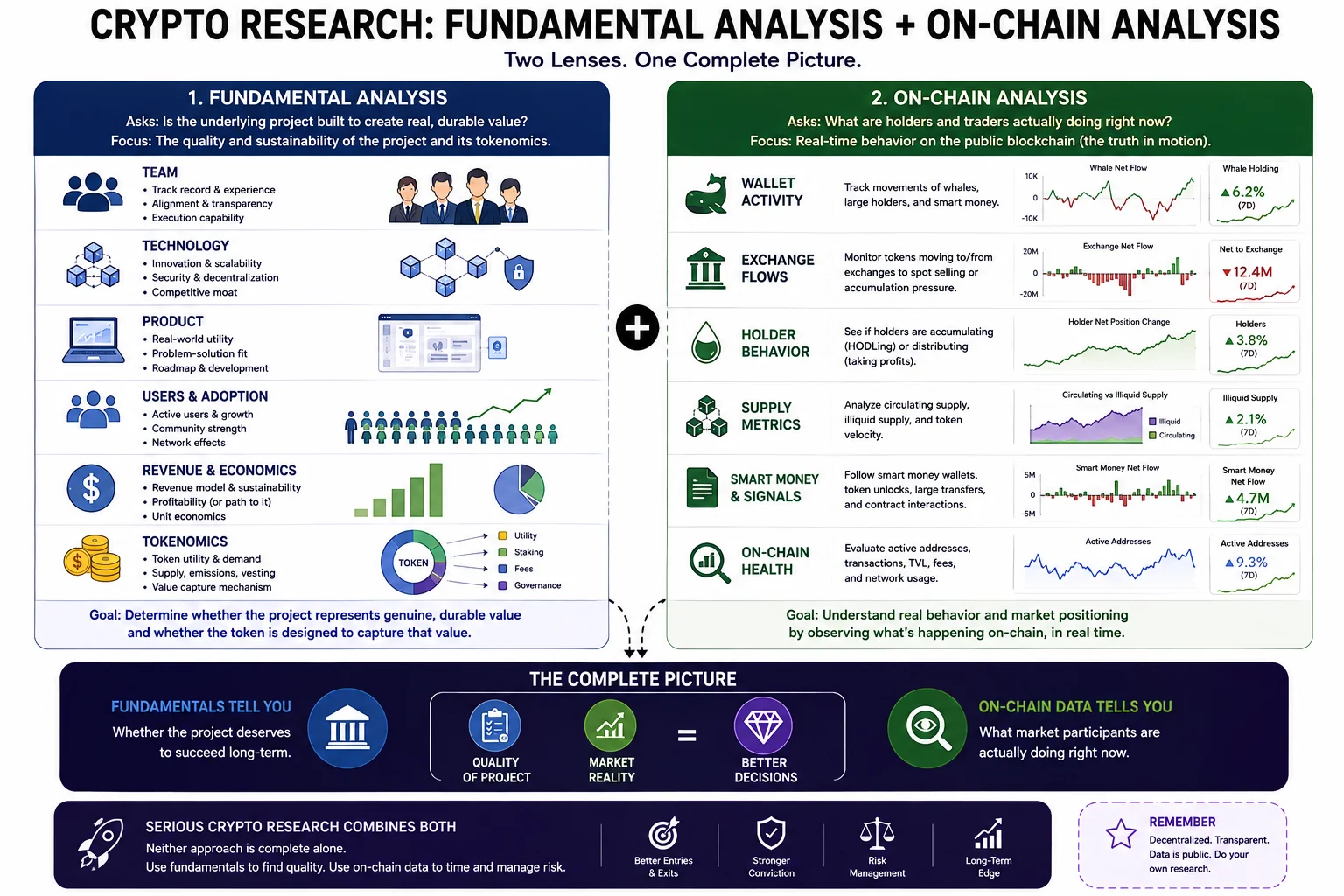
Market analysis in crypto requires triangulating multiple analytical frameworks. While fundamental and on-chain metrics provide deep insight into project substance and ledger movement (detailed in our comprehensive analysis section above), market participants also rely heavily on technical price dynamics.
Technical analysis studies price and volume patterns on charts — candlesticks (showing open, high, low, close for a period), support and resistance levels (prices where buying or selling pressure has historically clustered), moving averages (smoothing price trends), and momentum indicators like RSI and MACD. It's widely used but epistemically contested: it can describe crowd psychology and self-fulfilling levels reasonably well, but its predictive power beyond that is debated even among professional traders, and crypto's thinner liquidity makes it more prone to manipulation than deep traditional markets.
On-chain analysis is crypto's genuinely novel addition to market analysis: because blockchains are public, analysts can track active addresses, exchange inflows and outflows (large inflows to exchanges often precede selling), whale wallet movements, and stablecoin flows as real-time indicators unavailable in traditional markets where order flow and holder behavior are opaque. No single method is sufficient alone — the strongest analysis triangulates fundamentals, technicals, and on-chain data rather than relying on any one lens.
Data snapshot
Takeaway
On-chain data is the one analytical tool crypto has that traditional markets don't — and it's still underused relative to price-chart analysis.
Crypto Cycles
Crypto has historically moved in pronounced bull and bear cycles, more exaggerated than most traditional asset classes. An accumulation phase (quiet buying after a crash, before broad attention returns) tends to precede a bull market; a distribution phase (early holders and insiders selling into rising demand) tends to precede the subsequent bear market. Bitcoin's four-year halving cycle has historically — though not with certainty, and correlation isn't proof of causation — lined up loosely with major bull market peaks, roughly 12-18 months after each halving.
'Altcoin season' describes periods where capital rotates from Bitcoin into smaller-cap alternatives, often late in a bull cycle as risk appetite peaks; this rotation reverses sharply and often violently when sentiment turns, since altcoins are typically far less liquid than Bitcoin. Market psychology — FOMO (fear of missing out) driving late-cycle buying, and panic selling amplifying downturns — is a well-documented behavioral pattern, not unique to crypto but often more extreme in it, given thinner liquidity, 24/7 markets, and a retail-heavy participant base.
Crypto's relationship with global markets has strengthened over time rather than weakened, contrary to early 'uncorrelated asset' narratives — Bitcoin increasingly moves with risk sentiment broadly (tech stocks, interest rate expectations, dollar strength) rather than independently of it, especially since institutional adoption deepened the connection between crypto and traditional macro flows.
Data snapshot
Takeaway
Treat 'this time follows the pattern' claims with real skepticism — past cycles rhyme, but the growing correlation with traditional markets is a genuine structural change from crypto's early years.
Crypto Security
Most crypto losses today don't come from broken cryptography — they come from social engineering. Phishing sites that mimic real exchanges or wallets, fake tokens airdropped to wallets to lure victims into a malicious swap, wallet drainers (malicious smart contracts disguised as legitimate mints or claims that request a broad token-approval signature and then empty the wallet), and SIM swapping (hijacking a victim's phone number to bypass SMS-based two-factor authentication) account for the overwhelming majority of individual losses.
Rug pulls (developers abandoning a project and disappearing with funds), pump-and-dumps (coordinated buying to inflate price before dumping on later buyers), and fake influencer endorsements exploit trust and urgency rather than any technical vulnerability. Fake airdrops — messages claiming a wallet is eligible for a free token claim — are almost always a pretext to get a victim to connect their wallet to a malicious site and sign an approval that grants the attacker spending rights.
Practical protection follows a short, unglamorous list: verify URLs character-by-character rather than trusting a search result or a link in a message, never share a seed phrase with anyone or any website under any circumstance, use a hardware wallet for meaningful holdings, revoke unused token approvals periodically, and treat unsolicited contact — a support agent, a project team member, a 'verification' request — as hostile by default. Verifying a project before interacting with it means checking contract addresses against official sources, reviewing audit reports (and understanding an audit reduces but doesn't eliminate risk), and being skeptical of guaranteed or unusually high returns.
Data snapshot
Takeaway
Crypto security has quietly become a human-behavior problem more than a cryptography problem — the code got harder to break, so attackers went after the people instead.
Crypto Scams
It's worth being precise about categories rather than calling everything 'a scam.' A legitimate project has a real, verifiable team, transparent tokenomics, and a product that functions as described. A high-risk project may be entirely honest but speculative, unproven, or poorly designed — risk of loss without intent to deceive. A scam involves deliberate deception for the operators' financial benefit.
Within scams, structures repeat: a Ponzi scheme pays early investors with new investors' money rather than genuine returns, collapsing once new deposits slow; a pyramid scheme requires participants to recruit others for compensation, with money flowing upward through a growing base that mathematically cannot sustain itself; a rug pull sees developers withdraw project liquidity and disappear, often after building hype and a token price; a honeypot token is coded so buyers can purchase but structurally cannot sell.
Fake presales and fake airdrops exploit anticipation of a real launch to collect payment or wallet access for something that will never deliver. Celebrity-endorsed token scams exploit borrowed trust — a well-known figure's name attached to a project (sometimes without genuine authorization) to manufacture legitimacy. Romance and investment scams — often called 'pig butchering' in industry usage — combine a fabricated personal relationship with a fake trading platform, coaching a victim to deposit increasing amounts before vanishing; these are now one of the largest sources of individual crypto losses globally, run at industrial scale by organized criminal operations.
Data snapshot
Takeaway
Most crypto scams are old fraud patterns — Ponzi, pyramid, romance con — wearing new technical vocabulary, not fundamentally new kinds of crime.
Regulation & Government (with a focus on India)
Governments care about crypto for overlapping reasons: consumer protection after high-profile collapses, tax revenue, anti-money-laundering and counter-terrorism-financing obligations, and monetary sovereignty concerns if privately-issued stablecoins meaningfully substitute for national currency. The central, still-unresolved global legal question is classification — is a given token a security (subject to disclosure and registration rules), a commodity (lighter-touch regulation), or something else entirely — and different regulators in different countries have reached different, sometimes conflicting, answers.
KYC (Know Your Customer) and AML (Anti-Money Laundering) requirements now apply to most licensed exchanges globally, requiring identity verification and transaction monitoring similar to traditional banks. CBDCs (Central Bank Digital Currencies) are a related but distinct development — state-issued digital currency, centrally controlled, often explored partly as a defensive response to private stablecoins and crypto more broadly.
India's regulatory posture has been notably cautious and revenue-focused rather than adoption-focused. The Reserve Bank of India (RBI) has expressed longstanding skepticism toward private cryptocurrencies while developing its own CBDC pilot (the digital rupee); the Securities and Exchange Board of India (SEBI) has periodically been discussed as a potential regulator for crypto-as-securities but has not taken primary jurisdiction. Since the 2022 Union Budget, India taxes income from Virtual Digital Assets (VDAs) at a flat 30% rate with no deduction for losses against other income, alongside a 1% TDS (tax deducted at source) on transactions above certain thresholds — among the strictest tax treatments of any major economy, widely credited with pushing significant trading volume to offshore, less-regulated exchanges. As of this writing, India has neither banned crypto outright nor established a comprehensive licensing framework — a prolonged regulatory gray zone that content creators and traders should expect to keep shifting, and should verify against current government sources before acting on.
Data snapshot
Takeaway
India's crypto tax regime functions as de facto policy — it hasn't banned crypto, but it's taxed and structured trading toward the exits.
Crypto & Traditional Finance
The wall between crypto and traditional finance has thinned considerably. The approval of US spot Bitcoin ETFs in January 2024, followed by Ethereum ETFs later that year, gave institutional and retail investors regulated, custody-free exposure through ordinary brokerage accounts — removing a major adoption barrier and channeling billions in traditional investment capital directly into crypto markets. Hedge funds and asset managers now routinely allocate to crypto as a distinct asset class, and payment companies (PayPal, Visa, Mastercard among others) have built stablecoin settlement and crypto payment features directly into existing infrastructure.
Tokenization — representing traditional assets (bonds, real estate, private equity, money market funds) as blockchain-based tokens — is a genuinely significant trend distinct from speculative trading: it promises faster settlement, fractional ownership, and 24/7 markets for assets that traditionally trade only during limited hours through multiple slow intermediaries. Major asset managers have launched tokenized money market funds, and this 'real-world asset' (RWA) category is one of the more evidence-backed growth areas in crypto, tied to genuine efficiency gains rather than pure speculation.
Banks themselves increasingly use blockchain infrastructure for settlement and custody services even while remaining cautious about public, permissionless crypto assets — a distinction between 'we like the technology' and 'we're comfortable with the asset class' that's important not to collapse into a single narrative of 'banks are embracing crypto.'
Data snapshot
Takeaway
ETF approval didn't just add buyers — it fused crypto's price action more tightly to traditional market flows, for better and worse.
Real-World Applications
Beyond trading, crypto's most evidence-backed real-world use case is cross-border payments and remittances, particularly stablecoins moving value between countries faster and cheaper than traditional wire transfers or remittance services, which can charge fees of 5-10% or more on smaller transfers. This has genuine relevance for financial inclusion in regions with limited banking infrastructure or unstable local currencies, though it depends on reliable internet access and some technical literacy that not all target populations have.
Micropayments — transactions too small for traditional payment rails to process economically due to fixed processing fees — become viable on networks like Bitcoin's Lightning Network, opening use cases like pay-per-article content or machine-to-machine payments (Chapter 24). Digital identity and supply-chain tracking use blockchain's tamper-resistance to create verifiable, auditable records — provenance tracking for goods, credential verification — though these applications often work just as well with a permissioned database and don't strictly require a public blockchain's decentralization.
Tokenized real estate, bonds, and commodities extend fractional ownership and faster settlement to traditionally illiquid or slow-moving asset classes, letting smaller investors access markets previously reserved for large institutions. The honest caveat across most of these categories: many are still in pilot or early-adoption phases as of 2026, and separating genuine efficiency gains from speculative crypto-industry enthusiasm requires checking actual transaction volumes and institutional usage, not press releases.
Data snapshot
Takeaway
Cross-border payments and asset tokenization are crypto's strongest 'boring but real' use cases — less exciting than trading, more durable than most narratives built around it.
Crypto & AI
The intersection of AI and crypto is genuinely new territory, and worth separating hype from mechanism. The clearest, most concrete connection is machine-to-machine payments: autonomous AI agents that need to transact — paying for compute, data, or API access — without a human approving every transaction, which crypto's programmable, permissionless rails are structurally well-suited for in a way traditional banking rails (built around human account holders) are not.
DePIN (Decentralized Physical Infrastructure Networks) applies crypto incentive design to real-world infrastructure — GPU compute networks that let anyone contribute spare processing power in exchange for tokens, competing with centralized cloud providers for AI training and inference workloads; similar models exist for wireless networks, storage, and sensor data. Whether these token-incentivized networks can genuinely compete with hyperscale cloud providers on cost, reliability, and scale at AI-relevant workloads remains a real open question rather than a settled success.
AI-generated tokens and 'decentralized AI' projects are, as a category, particularly prone to attaching genuine AI research to speculative token launches with little connection between the two — evaluate these with extra scrutiny, since 'AI' and 'crypto' are currently two of the most hype-susceptible words in tech, and their combination compounds rather than cancels that risk. The most serious long-term concern in this space is AI-driven financial systems making autonomous, high-speed decisions across crypto markets with limited human oversight — a risk regulators and researchers are actively studying rather than one with established mitigations yet.
Data snapshot
Takeaway
Machine-to-machine payments are the most technically grounded crypto-AI connection; most 'AI coin' launches are marketing riding two hype cycles at once.
Crypto Infrastructure
The scaling problem — a blockchain can be secure, decentralized, or cheaply scalable, but not maximize all three simultaneously (the 'blockchain trilemma') — is what the entire Layer 1/Layer 2/Layer 3 stack exists to manage. Layer 1s (Bitcoin, Ethereum, Solana) are base settlement chains with their own validators and security. Layer 2s (rollups, sidechains) build on top of a Layer 1's security while processing transactions faster and cheaper. Layer 3s take this further, specializing for specific applications on top of a Layer 2.
Bridges let assets and data move between separate chains — and are, empirically, among the most exploited pieces of infrastructure in all of crypto, because they concentrate large amounts of locked value behind a smaller, often more centralized set of validating parties than the chains they connect (Chapter 30). Oracles solve a different problem: blockchains can't natively see outside data (prices, weather, sports results), so oracle networks like Chainlink fetch and deliver that data on-chain, with strong economic incentives to be accurate since so much DeFi value depends on it.
Sequencers — the entities that order and batch transactions for a rollup before posting them to the base layer — are frequently a single, centralized operator in current rollup designs, a known and openly acknowledged gap between the 'decentralized Layer 2' marketing and the current technical reality; decentralizing sequencing is an active area of protocol research. Zero-knowledge proofs let one party prove a computation was done correctly without revealing the underlying data — used both for privacy and for ZK-rollup scaling, where a compact proof stands in for verifying every individual transaction. Data availability (making sure the underlying transaction data is actually accessible for verification, not just the compressed proof) has become its own specialized infrastructure layer as modular blockchain designs split execution, settlement, and data availability into separate, purpose-built systems rather than one chain doing everything.
Data snapshot
Takeaway
Layer 2 scaling solved the throughput problem faster than it solved the decentralization problem — many rollups today are still meaningfully centralized under the hood.
Mining & Staking
Proof of Work mining is fundamentally an economic race: specialized hardware (ASICs, for Bitcoin) competes to solve a cryptographic puzzle, with electricity cost as the dominant ongoing expense. Miners typically join mining pools to combine computing power and share rewards more predictably rather than gambling on solo mining a block outright. Mining economics come down to a simple equation — block reward plus fees, versus hardware cost plus electricity — which is why miners cluster in regions with the cheapest available power, and why profitability compresses over time as difficulty rises and block rewards halve.
Proof of Stake replaces this physical competition with financial commitment: validators lock up (stake) capital as collateral, are algorithmically selected to propose and attest to blocks, and earn rewards for honest participation. Slashing — the forced loss of some or all staked collateral — punishes provable misbehavior (double-signing, extended downtime), replacing Proof of Work's energy cost with an economic penalty as the deterrent against attacking the network.
Delegation lets smaller holders stake through a validator they don't personally run, earning a share of rewards minus the validator's commission — convenient, but it also concentrates voting and validating power toward whichever validators attract the most delegated stake. Liquid staking (receiving a tradable receipt token representing staked assets, so capital isn't fully locked) and restaking (using already-staked assets as collateral to secure additional protocols simultaneously) have become major DeFi categories in their own right, but both add new layers of smart-contract and slashing risk on top of the base staking risk.
Data snapshot
Takeaway
Proof of Stake didn't eliminate centralization pressure — it just moved it from 'who has the cheapest electricity' to 'who attracts the most delegated stake.'
Environmental Debate
Bitcoin mining's electricity consumption is substantial and genuinely comparable to that of a mid-sized country by some estimates — this is a documented, measurable fact, not a disputed one. What is genuinely disputed is how to weigh that consumption: what share comes from renewable versus fossil sources (estimates vary significantly by study and methodology, and miners' incentive to seek the cheapest power sometimes means stranded or otherwise-wasted renewable and flare-gas energy that wouldn't otherwise be used), and how to compare that cost against the traditional financial and gold-mining infrastructure Bitcoin proponents argue it partially substitutes for.
Proof of Stake networks like Ethereum consume dramatically less energy than Proof of Work by design, since there's no physical computation race — this is the most concrete, uncontested environmental distinction in the entire industry, verified by Ethereum's own measured energy usage before and after the 2022 Merge (a reduction of over 99.9%). This is a genuine reason some environmentally-conscious investors and developers prefer Proof of Stake chains, separate from any other technical tradeoff.
Mining location has shifted considerably over the past several years, particularly after China's 2021 mining ban pushed operations toward the United States, and other regions with available power capacity, sometimes specifically toward stranded renewable or otherwise-underused energy (flared natural gas, curtailed wind and solar). The honest framing for a skeptic audience: present both the measured energy cost and the substitution and renewable-integration arguments, cite specific studies and their methodology, and resist treating either the 'Bitcoin is an environmental disaster' or 'Bitcoin is secretly green' framing as settled — the underlying data is real but the interpretation is where legitimate disagreement remains.
Data snapshot
Takeaway
The PoW-vs-PoS energy gap is settled science; the 'is Bitcoin mining net-good or net-bad for the grid and climate' question is not — treat them as separate claims.
Privacy Coins & Privacy Technology
Bitcoin is often mistakenly assumed to be anonymous — it's actually pseudonymous: every transaction is permanently public, and once an address is linked to a real identity (through an exchange KYC record, for instance), the entire transaction history tied to it becomes traceable. This is precisely why blockchain forensics firms can trace stolen funds (Chapter 19, 30) and why financial privacy became its own dedicated research area.
Monero uses ring signatures (mixing a real transaction with several decoy signatures so an outside observer can't determine which is genuine), stealth addresses (generating a unique one-time address for each transaction), and confidential transaction amounts to achieve strong privacy by default at the protocol level — a fundamentally different design choice than Bitcoin's transparent-by-default ledger. Zcash offers optional privacy through zero-knowledge proofs (zk-SNARKs), letting users choose between fully shielded and fully transparent transactions.
This creates a genuine, difficult tension: financial privacy is a legitimate value with real historical precedent (cash transactions have always been private), but privacy technology is also disproportionately targeted by regulators and has been delisted from a number of major exchanges in multiple jurisdictions specifically because it complicates anti-money-laundering enforcement. There is no way to present this fairly without acknowledging both sides carry real weight — privacy advocates point to surveillance and financial autonomy concerns; regulators point to documented use in ransomware payments and sanctions evasion. Coin mixing services (pooling transactions from multiple users to obscure trails on otherwise-transparent chains like Bitcoin) occupy a similar contested space and have drawn direct regulatory enforcement action in several major cases.
Data snapshot
Takeaway
Most public confusion about crypto privacy runs backward — Bitcoin is the transparent one; true privacy coins are a separate, much more contested category.
Crypto & Geopolitics
Stablecoins have become an unexpected extension of US dollar reach: in countries with high inflation, unstable currencies, or capital controls, dollar-pegged stablecoins offer easier access to dollar-denominated value than opening a foreign bank account — a phenomenon researchers increasingly describe as informal 'digital dollarization.' This is a genuinely two-sided story: it can offer real protection to individuals in unstable economies, while also potentially undermining a national government's monetary policy tools and formal capital controls at scale.
Sanctions and crypto's role in evading them is real but frequently overstated in popular narrative — blockchain analytics firms and law enforcement have gotten increasingly effective at tracing sanctioned flows precisely because public ledgers are traceable, and major exchanges routinely freeze or block sanctioned addresses. That said, crypto has documented, evidence-backed use in specific sanctions-evasion cases (including state-linked actors), and it remains a genuine policy concern even as its overall share of illicit finance is smaller than cash, by most law-enforcement and industry-analytics estimates.
Central Bank Digital Currencies represent governments' own answer to this landscape — state-controlled digital money that can offer some crypto-adjacent efficiency benefits while preserving (or in some critics' view, extending) central authority over monetary surveillance and control, a tension explored directly by China's digital yuan pilot and similar programs elsewhere. Mining geopolitics adds a resource-competition dimension: countries and regions compete for mining operations partly for economic activity and partly, in some cases, as a strategic hedge or bargaining chip in broader technology and energy policy. Bitcoin adoption in developing economies with unstable local currencies (parts of Latin America and Africa, most prominently) remains real but smaller in aggregate transaction volume than headline coverage often implies — worth verifying against current on-chain and survey data rather than anecdote.
Data snapshot
Takeaway
Stablecoins, not Bitcoin, are crypto's biggest live geopolitical story right now — they're quietly exporting dollar demand into economies governments would rather control.
Crypto Failures & Lessons
Mt. Gox (2014) — once handling roughly 70% of global Bitcoin trading volume — collapsed after losing approximately 850,000 BTC to a mix of hacking and poor security practices over several years before discovery; it remains the founding case study in exchange custody risk and the reason 'not your keys, not your coins' became a community mantra. Terra/LUNA (May 2022) showed how an algorithmic stablecoin's peg, once confidence broke, could unwind in days rather than years, destroying roughly $40 billion in combined value across UST and LUNA and triggering contagion across the broader market.
Celsius and Three Arrows Capital (2022) both collapsed from the same underlying cause with different business models on top: excessive leverage and risky, opaque lending decisions that worked fine in a rising market and became catastrophic once prices fell and counterparties couldn't meet obligations — a chain reaction that took down several other lenders and funds exposed to both. FTX (November 2022) was different in kind, not just scale: prosecutors and subsequent court proceedings established that customer deposits were commingled with and lent to Alameda Research, a trading firm under the same ownership, without customer knowledge or consent — a fraud case, not merely a risk-management failure, resulting in a criminal conviction for founder Sam Bankman-Fried.
Major bridge hacks (Ronin Bridge, ~$625M in March 2022; Wormhole, ~$325M in February 2022) and DeFi exploits repeatedly demonstrate the same lesson from Chapter 25: concentrating large value behind small, sometimes centralized sets of validating keys creates an outsized target. The consistent pattern across nearly every major failure in this chapter: what happened is usually clear quickly; why it happened traces to a specific human or design decision, not 'crypto' as an abstract category; who lost money is almost always retail depositors and users, disproportionately to the insiders and operators involved; and what the industry learned is real but slow to translate into universal practice — each failure has prompted better standards (proof of reserves, audit requirements, collateral transparency) that the next failure often reveals were still incompletely adopted.
Data snapshot
Takeaway
Nearly every major crypto collapse traces back to a specific human decision — hidden leverage, commingled funds, a centralized key — not an inherent flaw in blockchain technology itself.
Famous Crypto People & Organizations
Satoshi Nakamoto's identity remains unknown; Nakamoto authored the Bitcoin whitepaper and early code, then gradually withdrew from public involvement around 2010-2011, leaving an estimated ~1 million BTC in dormant, never-moved wallets — an enormous, unclaimed fortune that is itself a recurring subject of speculation and, occasionally, fraudulent identity claims that have been legally and technically discredited.
Vitalik Buterin co-founded Ethereum as a teenager and remains its most visible technical and philosophical voice, though Ethereum's actual development is distributed across multiple independent client teams and the Ethereum Foundation rather than controlled by Buterin alone — an important distinction between 'influential voice' and 'central authority.' Changpeng Zhao ('CZ') founded Binance, built it into the largest exchange by volume, then pleaded guilty in 2023 to US anti-money-laundering violations as part of a settlement that included stepping down as CEO and a personal fine, alongside a record corporate penalty for Binance. Brian Armstrong co-founded and leads Coinbase, the largest US-based publicly listed exchange, positioning the company around regulatory compliance as a competitive strategy relative to offshore rivals.
Michael Saylor, through his company Strategy (formerly MicroStrategy), pioneered the corporate strategy of raising capital specifically to buy and hold Bitcoin on the company balance sheet, a model since partially imitated by other public companies — evaluate this pattern's risks (leverage, dilution, correlation to BTC price) as carefully as its returns. Major venture capital firms (a16z crypto, Paradigm, and others) and blockchain foundations fund a large share of the ecosystem's development; their financial stake in projects they publicly promote is a real, disclosed conflict of interest worth factoring into how their public commentary is weighed, not evidence of dishonesty by default.
Data snapshot
Takeaway
Track record, incentives, and actual authority (versus visibility) — not charisma or follower count — are the right lenses for evaluating any prominent crypto figure.
Crypto Criticism
The strongest good-faith criticisms deserve direct engagement, not dismissal. Is Bitcoin actually useful? Its use as a payment method for everyday commerce remains minor relative to its use as a speculative and store-of-value asset — critics reasonably ask whether 'digital gold' is a retreat from the original payments vision rather than its fulfillment. Is crypto mostly speculation? By trading volume and price volatility, yes, overwhelmingly — genuine utility usage (payments, remittances, DeFi lending against real collateral) is real but represents a modest fraction of total activity compared to trading and holding for price appreciation.
Is decentralization exaggerated? Frequently, yes — Chapters 6, 14, 25, and 26 each document real centralization pressures (mining pools, validator concentration, centralized sequencers, VC-concentrated governance tokens) that complicate marketing claims of full decentralization. Can blockchain scale? Meaningfully better than five years ago via Layer 2s, but base-layer throughput limits remain real, and 'decentralized, secure, and cheaply scalable, all at once' remains an unsolved engineering tradeoff, not a solved problem.
Is crypto used for crime? Yes, measurably, though by most industry and law-enforcement analytics its share of total illicit finance is smaller than cash — both facts can be true simultaneously, and neither erases the other. Are tokens securities? Genuinely unresolved and actively litigated in multiple jurisdictions, with different regulators reaching different conclusions about the same or similar assets. Do cryptocurrencies create wealth or redistribute it? Largely redistributive in speculative cycles — later buyers frequently transfer wealth to earlier holders and insiders — with genuine value creation concentrated in specific infrastructure and payments use cases rather than token price appreciation broadly. Does crypto solve problems that already have solutions? Sometimes — for well-banked users in stable economies, a traditional bank account often does the job crypto claims to improve on, with far less complexity and risk.
Data snapshot
Takeaway
The best crypto criticism isn't 'it's all fake' — it's specific, falsifiable claims about decentralization, usage, and value capture that deserve to be checked against actual data, case by case.
The Biggest Debate: Bitcoin vs. Traditional Finance
Control in traditional finance sits with regulated institutions — banks, brokers, clearinghouses — accountable to regulators and, in principle, deposit insurance and legal recourse. Control in crypto sits with the protocol and network, with accountability distributed (and, per Chapters 6, 14, 25, 26, sometimes more concentrated than advertised) rather than centralized in an accountable institution.
Custody follows the same split: traditional finance defaults to institutional custody with legal protections (and failure points, as 2008 demonstrated); crypto defaults to user or third-party custody with no equivalent deposit insurance in most jurisdictions, and no institution to appeal to if self-custody goes wrong. Settlement in traditional finance still often takes one to several business days for many transaction types (though modern real-time payment rails narrow this in some markets); blockchain settlement typically finalizes in minutes and is visible in real time, a genuine and underappreciated efficiency advantage.
Reversibility is one of the sharpest, most consequential differences: a fraudulent traditional charge can often be disputed and reversed through the card network or bank; a confirmed blockchain transaction generally cannot be reversed by anyone, for any reason — this cuts both ways, protecting against arbitrary institutional freezes while removing recourse against theft or error. Transparency also cuts differently than intuition suggests: public blockchains are, on their face, more transparent than most private bank ledgers — but that transparency is at the transaction level, not necessarily at the level of who controls a protocol's development, treasury, or governance, which can be just as opaque as any traditional institution.
Data snapshot
Takeaway
Every one of these tradeoffs cuts both ways — faster and final beats slower and reversible for some use cases, and loses badly for others. Neither system is strictly better; they're optimized for different failure modes.
Future of Crypto
Over the next decade, Bitcoin's most likely trajectory continues along two tracks simultaneously: growing institutional store-of-value adoption (through ETFs, corporate treasuries, and potentially sovereign reserves) alongside persistently limited use as a direct medium of exchange, with the Lightning Network and similar layers determining how much that changes. Ethereum's future depends heavily on whether its rollup-centric scaling roadmap delivers cheap, fast transactions at genuine scale while preserving meaningful decentralization — the central bet the entire ecosystem is currently making.
Stablecoins are likely to keep growing in both usage and regulatory scrutiny simultaneously, as governments increasingly recognize them as consequential financial infrastructure rather than a crypto-native curiosity — expect more explicit stablecoin-specific legislation globally, following the pattern of the US GENIUS Act framework. CBDCs will likely continue rolling out in pilot and limited-production form across multiple countries, coexisting with rather than replacing private stablecoins and crypto in most scenarios researchers currently consider plausible.
Tokenized real-world assets, AI-crypto integration (particularly machine payments and DePIN), and decentralized identity are the categories with the most concrete, currently-visible momentum toward genuine adoption rather than pure speculation. Institutional adoption and regulatory clarity are mutually reinforcing — each tends to accelerate the other — while quantum computing remains a longer-horizon technical risk the field is actively preparing for rather than an imminent threat. Mass consumer adoption of crypto for everyday, non-speculative use remains the least certain outcome on this list; it depends on user experience improvements (removing seed phrases and gas fees from the average user's mental model entirely) that are technically underway but not yet complete.
Data snapshot
Takeaway
The most confidently predictable part of crypto's future is quieter than the headlines — stablecoins and tokenized assets, not price moonshots, are where the evidence points most strongly.
The Ultimate Question

Every framing offered at the start of this chapter is defensible, and that's the point: crypto is not one thing being evaluated by one standard. Is it the future of money? For a narrow slice of use cases — cross-border stablecoin payments, censorship-resistant value transfer, programmable settlement — the evidence supports a real yes. Is it a new financial technology rather than a new form of money? For most current activity, this is the more accurate description: a faster, more transparent settlement layer bolted onto existing financial logic, not a wholesale replacement of it.
Is Bitcoin the important innovation while thousands of tokens are speculation? This chapter's evidence leans toward yes, with real nuance: Bitcoin and Ethereum have durable, demonstrated network effects and infrastructure roles; the vast majority of the remaining ~20,000+ tokens in existence have neither meaningful usage nor a credible path to it, and many are explicitly designed as short-term speculative vehicles rather than infrastructure. Will governments absorb the useful parts of blockchain technology while restricting or eliminating the parts they find threatening — permissionless access, financial privacy, monetary competition? This is already visibly happening, from CBDCs to stablecoin regulation to enforcement actions against unlicensed platforms, and is a more evidence-grounded prediction than either crypto maximalism or crypto dismissal.
The most uncomfortable and most useful question to end on: will crypto change the financial system, or will the financial system simply absorb crypto? The honest answer, based on everything in this book, is: both, unevenly, at the same time. Stablecoins are absorbing crypto's dollar-payments efficiency into existing monetary systems rather than replacing them. Tokenization is absorbing blockchain's settlement advantages into traditional asset classes rather than creating an entirely parallel financial system. Bitcoin persists as a genuinely novel, hard-to-absorb asset precisely because its value proposition — fixed, unconfiscatable scarcity outside any institution's control — is the one property traditional finance structurally cannot replicate by adopting the technology. That may be crypto's most durable legacy: not a revolution that replaced the old system, but a permanent, evolving pressure test on what money, ownership, and trust actually require — and a live demonstration, mistakes included, of what happens when you try to answer that question with code instead of institutions.
Data snapshot
Takeaway
Crypto's real legacy may not be replacing the financial system — it may be permanently changing what that system has to prove it can do better.
A Note on Sourcing
Facts about protocol mechanics, historical events, and well-established figures (supply caps, halving schedules, dates of major collapses, consensus mechanisms) reflect established, verifiable industry knowledge. Market prices, regulatory status, and 'current' figures reflect information available around the time of writing and should be re-verified before being used in any published, financial, or advisory context — this is one of the fastest-moving industries in the reference to check.
This book intentionally avoids financial advice. Nothing here should be read as a recommendation to buy, sell, or hold any asset.