Skip to content
Chang Research
Live

MODULE 05 · Start from zero

Risk Management: How to Stay in the Game Long Enough to Win

Protect your capital first. Position sizing, stop-losses, risk-reward ratios and why big losses are so hard to recover.

Beginner7 min readIndia-focused examples

Published by Chang Research Base · Last reviewed · Educational content, not investment advice (disclaimer)

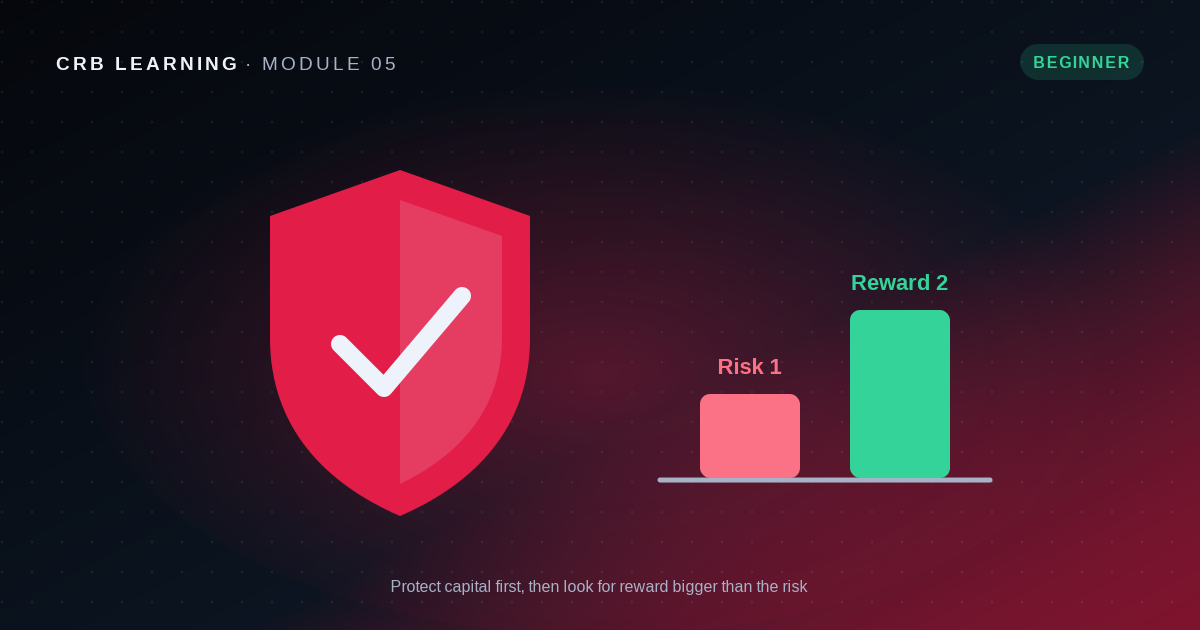
Illustration of a shield with a tick mark beside a balance showing one unit of risk against two units of reward

Why this matters

Beginners ask, "How much can I make?" Experienced traders ask, "How much can I lose?"

You cannot control whether a trade wins. You can fully control how much you lose when it does not.

Risk management is the boring part of markets. It is also the part that decides who is still around after five years.

Why losses hurt more than gains help

Losses and gains are not equal. The deeper the hole, the harder the climb.

If you loseYou need this gain to get back
10%11%
20%25%
50%100%
80%400%

Lose half your money and you must double what is left just to be back where you started. That is why protecting capital comes first.

The 1% rule

Decide the maximum you are willing to lose on a single trade. A common guideline is 1% of your trading capital, and not more than 2%.

With ₹1,00,000, that is ₹1,000 per trade. Ten losing trades in a row would cost about 10% of your capital. Painful, but you survive and keep learning.

Without this rule, two or three bad trades can end your journey.

Stop-loss: your exit door

A stop-loss is the price at which you accept you were wrong and get out.

Set it before you enter, at a level where your trade idea no longer makes sense, such as just below a support level. Do not pick it based on how much loss "feels okay".

Two honest warnings:

  • A stop-loss is not a guarantee. If a stock opens far lower after bad news, your order fills at the lower price.
  • Moving your stop-loss further away to "give it room" is how small losses become big ones.

Position sizing: how many shares to buy

This is the most useful formula in trading:

Quantity = Money you will risk ÷ (Entry price − Stop-loss price)

It flips the usual thinking. You do not start with "how many can I afford?". You start with "how much can I lose?" and work backwards.

Risk-reward ratio

Compare what you could lose with what you could gain.

If you risk ₹20 per share to aim for ₹40, your risk-reward is 1:2.

At 1:2, you can be wrong on 6 trades out of 10 and still come out ahead: 4 wins × 2 = 8 units gained, 6 losses × 1 = 6 units lost. You do not need to be right most of the time. You need your wins to be bigger than your losses.

Risk at the portfolio level

  • Diversify: do not put everything in one stock or one sector. Five bank stocks are not five different bets.
  • Limit total exposure: if every open trade hit its stop-loss today, how much would you lose? Keep that number comfortable.
  • Respect drawdowns: if your account falls by a set amount, say 10%, stop and review before trading again.
  • Avoid leverage early: borrowed money multiplies mistakes.

Real-world example

Example: sizing one trade

Sneha has ₹1,00,000 for trading and follows the 1% rule. The stock prices are illustrative.

  • Maximum risk per trade: 1% of ₹1,00,000 = ₹1,000.
  • She wants to buy at ₹500 with a stop-loss at ₹480. Risk per share = ₹20.
  • Quantity = ₹1,000 ÷ ₹20 = 50 shares.
  • Position value = 50 × ₹500 = ₹25,000.
  • Her target is ₹540. Reward per share = ₹40, so risk-reward is 1:2.

If she is wrong, she loses about ₹1,000 (plus charges). If she is right, she makes about ₹2,000. Either way, her account is fine tomorrow.

Key terms and what they mean

Capital
The total money you have set aside for trading or investing.
Stop-loss
A pre-decided price at which you exit a losing trade.
Position size
How much of a stock you buy in one trade.
Risk-reward ratio
Potential loss compared with potential gain on a trade.
Drawdown
The fall in your account from its highest point.
Diversification
Spreading money across different investments so one failure does not sink you.
Leverage
Using borrowed money or margin to take a bigger position.
Gap
When a price opens much higher or lower than the previous close.

Benefits, risks and limits

What is good about it

  • No single trade can seriously damage your account.
  • Decisions get calmer, because the worst case is already known.
  • You can be wrong often and still grow your capital.

Risks and limits

  • Stop-losses can be skipped over in gaps and fast markets.
  • Very tight stop-losses get hit by normal daily movement.
  • Rules only work if you follow them when it is emotionally hard.
  • Risk management limits losses. It cannot turn a bad strategy into a good one.

Common mistakes beginners make

  1. Entering a trade with no stop-loss "just this once".
  2. Averaging down: buying more of a falling trade to lower the average price.
  3. Risking more after a loss to recover quickly.
  4. Putting most of the capital into one "sure" idea.
  5. Ignoring brokerage and taxes when calculating risk and reward.

Key takeaways

  • Protect capital first. Profit comes second.
  • Risk about 1% of your capital per trade.
  • Decide your stop-loss and quantity before you buy.
  • Aim for wins that are at least twice your losses.

Frequently asked questions

What is the 2% rule in trading?

It is a guideline that says you should not risk more than 2% of your trading capital on any single trade. Many beginners use an even stricter 1% limit while they are learning.

Where should I place my stop-loss?

At a price that proves your idea wrong, such as below a recent swing low or support level for a buy trade. Then adjust your quantity so the loss at that price stays within your risk limit.

Do long-term investors need risk management?

Yes, but it looks different. Instead of stop-losses, long-term investors manage risk through diversification, sensible asset allocation, an emergency fund and by not investing money they will need soon.

What is a good risk-reward ratio?

Many traders look for at least 1:2, meaning the possible gain is twice the possible loss. A higher ratio lets you stay profitable with a lower win rate.

Sources and further checking

Examples use made-up or rounded numbers unless a date and source are given. Rules, rates and contract details change, so confirm them with the official source before acting. This lesson is for education only and is not investment, tax or legal advice. See the disclaimer.