Skip to content
Chang Research
Live

MODULE 14 · Handle complex products

Futures Trading Basics: Leverage, Margin and Why Small Moves Hit Hard

Leverage, margin, mark-to-market, expiry and rollover. How futures work in India and why small moves create big swings.

Advanced7 min readIndia-focused examples

Published by Chang Research Base · Last reviewed · Educational content, not investment advice (disclaimer)

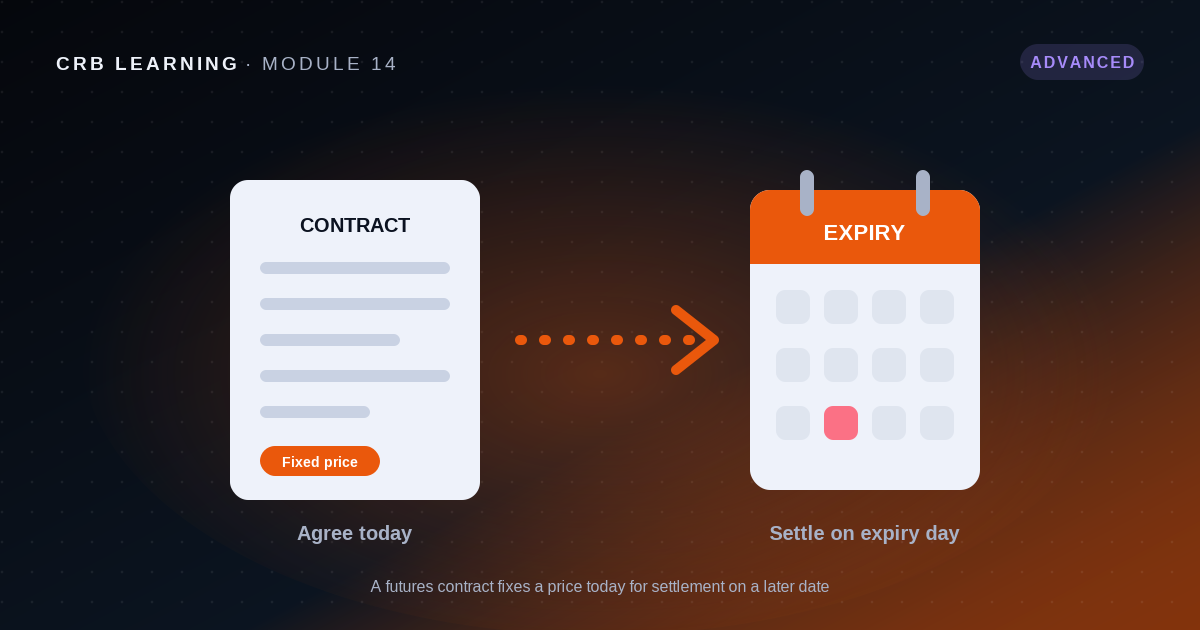
Illustration of a contract document linked by an arrow from today to an expiry date on a calendar

Why this matters

With shares, you pay ₹1 lakh to own ₹1 lakh of stock. With futures, you can control ₹16 lakh of the Nifty by putting up only a fraction of that.

That is leverage. It is the reason futures attract traders, and the reason they wipe out accounts.

This lesson explains the mechanics in plain English so you understand the risk before the excitement.

What is a futures contract?

Read this first. SEBI's studies of individual traders in equity futures and options found that about 91% lost money in FY 2024-25 and about 88% lost money in FY 2025-26. This is not a beginner-friendly product. Learn it fully before you put in any money.

A futures contract is an agreement to buy or sell something at a fixed price on a future date.

Think of a farmer and a biscuit maker. In June they agree that the farmer will sell wheat at ₹2,500 a quintal in September. Both now have certainty. The farmer is protected if prices fall. The biscuit maker is protected if prices rise.

Stock market futures work on the same idea, with the Nifty, Bank Nifty or individual stocks instead of wheat. Most traders never want delivery. They simply want to profit from the price change.

Futures are a type of derivative: their value is derived from something else, called the underlying.

Lot size and margin

You cannot buy one unit of a future. You trade in fixed bundles called lots. The Nifty 50 lot size is 65 (revised from 75 for contracts from January 2026). Exchanges revise lot sizes from time to time.

You do not pay the full contract value. You deposit a margin, a security deposit the exchange requires, made up of SPAN margin and exposure margin.

The margin is only a fraction of the contract value. The exact amount changes with volatility, and your broker shows it before you place the order.

Leverage: the double-edged sword

Because you put up a small margin for a large position, a small move in the index becomes a large move on your money.

If your margin is about one-eighth of the contract value, a 1% move in the index changes your margin money by about 8%. A 5% move against you could take 40% of it.

Leverage does not change how often you are right. It only makes each right and wrong decision bigger.

Mark-to-market: settled every day

With shares, a loss is only "on paper" until you sell. Futures are different.

Every evening the exchange settles your profit or loss at that day's closing price. This is mark-to-market (MTM). Profit is added to your account. Loss is taken out in cash.

If losses reduce your balance below the required margin, you get a margin call. You must add money, or the broker can close your position at the market price.

So you can be right about the direction in the end and still be forced out by a move against you in between.

Expiry and rollover

Every futures contract has an end date, called expiry. On NSE, monthly index and stock futures expire on the last Tuesday of the month.

  • Index futures are settled in cash.
  • Stock futures are physically settled. If you hold until expiry, you must actually take or give delivery of the shares, which needs the full amount.

To hold a view beyond expiry, traders roll over: close the current month's contract and open next month's. Rollover has a cost.

The futures price is usually a little different from the actual (spot) price. That gap is called the basis, and it shrinks to zero at expiry.

Why futures exist: hedging and speculation

  • Hedging: reducing risk you already have. An investor with a large share portfolio who fears a short-term fall can sell Nifty futures. If the market drops, the futures profit offsets part of the portfolio loss.
  • Speculation: betting on direction with leverage. Futures also let you profit from falling prices by selling first, called going short.
  • Arbitrage: large players earn small, low-risk profits from price gaps between the spot and futures markets.

Hedging is what futures were designed for. Most retail activity, however, is speculation.

Real-world example

Example: one lot of Nifty futures

The index level and margin here are round, illustrative numbers. Check live values with your broker.

  • Nifty futures price: 25,000. Lot size: 65.
  • Contract value = 25,000 × 65 = ₹16,25,000.
  • Assume the required margin is about ₹2,00,000.

If Nifty rises 1% to 25,250: profit = 250 points × 65 = ₹16,250. That is about 8% on the margin.

If Nifty falls 1% to 24,750: loss = ₹16,250, taken from your account the same evening.

If Nifty falls 4%: loss = 1,000 points × 65 = ₹65,000, nearly a third of the margin, from a move the market can make in a few bad days.

Charges and taxes, including STT of 0.05% on the sell side, come on top.

Key terms and what they mean

Derivative
A contract whose value depends on another asset, the underlying.
Underlying
The asset a derivative is based on, such as the Nifty 50 or a stock.
Lot size
The fixed number of units in one contract.
Margin
The deposit required to open and hold a futures position.
Mark-to-market (MTM)
Daily settlement of profit and loss at the closing price.
Margin call
A demand to add funds when losses reduce your margin below the required level.
Long / short
Long means you bought and profit if price rises. Short means you sold first and profit if price falls.
Rollover
Moving a position from the expiring contract to a later one.
Basis
The difference between the futures price and the spot price.

Benefits, risks and limits

What is good about it

  • Useful for hedging an existing portfolio against short-term falls.
  • You can take a view on falling prices, not only rising ones.
  • Index futures are very liquid, with tight bid-ask spreads.
  • Pricing is simple compared with options: profit and loss move point for point.

Risks and limits

  • Losses are not limited to your margin. In a sharp move you can owe more than you deposited.
  • Daily MTM can force you out before your view plays out.
  • Overnight gaps can jump past your stop-loss.
  • Contract values are large, so even one lot is a big position for a small account.

Common mistakes beginners make

  1. Thinking of the margin as the amount at risk, instead of the full contract value.
  2. Using all available capital as margin, leaving nothing for MTM losses.
  3. Holding stock futures into expiry without knowing about physical settlement.
  4. Trading futures before being consistently profitable in the cash market.
  5. Having no stop-loss because "it will come back".

Key takeaways

  • A future is a leveraged agreement on a future price.
  • Margin is a deposit, not the maximum loss.
  • Profits and losses are settled in cash every single day.
  • Futures are a hedging tool first. Treat speculation with great care.

Frequently asked questions

What is the difference between futures and options?

A futures contract is an obligation for both sides to trade at the agreed price. An option gives its buyer a right, not an obligation, in exchange for a premium. Futures profits and losses move one-for-one with the price, while an option buyer's loss is limited to the premium paid.

How much money do I need to trade Nifty futures?

You need the exchange-mandated margin for one lot, which is a fraction of the contract value and changes with volatility. You also need a healthy buffer above it to absorb daily mark-to-market losses, so the margin alone is not enough.

Can I lose more than my margin in futures?

Yes. Your loss depends on how far the price moves, not on how much margin you deposited. In a sharp or gap move, the loss can exceed the margin and you would owe the difference to your broker.

What happens if I hold a futures contract until expiry?

Index futures are settled in cash at the final settlement price. Stock futures are physically settled, which means you must take or give delivery of the shares and arrange the full value or the shares.

Sources and further checking

Examples use made-up or rounded numbers unless a date and source are given. Rules, rates and contract details change, so confirm them with the official source before acting. This lesson is for education only and is not investment, tax or legal advice. See the disclaimer.