Skip to content
Chang Research
Live

MODULE 15 · Handle complex products

Options Trading Basics: Calls, Puts and the Maths Nobody Tells You

Calls, puts, premium, strike and expiry. Then the Greeks, implied volatility and why most option buyers lose money.

Advanced9 min readIndia-focused examples

Published by Chang Research Base · Last reviewed · Educational content, not investment advice (disclaimer)

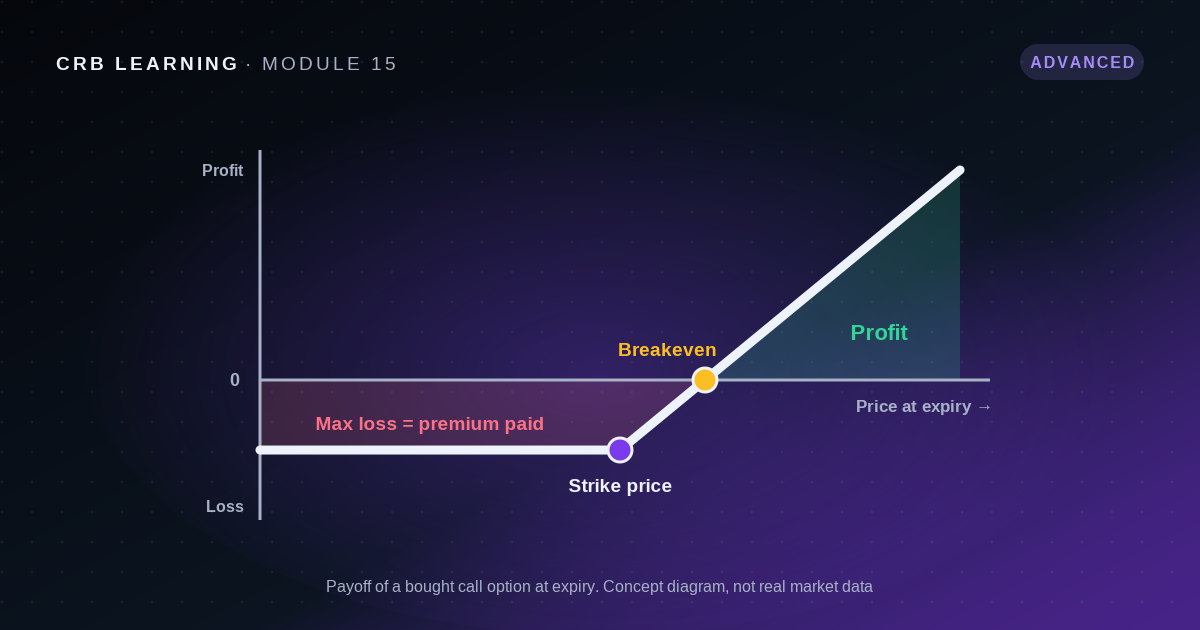
Payoff diagram illustration of a call option: flat loss limited to the premium, then rising profit above the breakeven

Why this matters

Options are the most talked about product in Indian markets. A small premium, a big possible payoff and weekly expiries make them feel like a shortcut.

They are not. Options are a tool with moving parts that most new traders never learn: time decay, volatility and probability.

This lesson explains those parts in simple English, so you know exactly what you are buying.

What is an option?

Read this first. SEBI's studies of individual traders in equity futures and options found that about 91% lost money in FY 2024-25 and about 88% lost money in FY 2025-26. This is not a beginner-friendly product. Learn it fully before you put in any money.

An option is a contract that gives the buyer a right, but not an obligation, to buy or sell something at a fixed price before a fixed date.

Think of a token advance on a flat. You pay ₹50,000 to lock in a price of ₹50 lakh for three months. If prices jump, you use your right and benefit. If prices fall, you walk away and lose only the ₹50,000.

That token amount is the premium. The locked price is the strike price. The three-month deadline is the expiry.

Calls and puts

  • A call option (CE) is the right to buy. Call buyers profit when the price goes up.
  • A put option (PE) is the right to sell. Put buyers profit when the price goes down.

Every option has a buyer and a seller (also called the writer).

BuyerSeller (writer)
Pays or receivesPays the premiumReceives the premium
Maximum lossThe premium paidVery large, and unlimited for a call seller
Maximum profitVery largeThe premium received
Margin neededNo, only the premiumYes, a large margin
Time passingHurtsHelps

On NSE, index options are settled in cash and stock options are physically settled. Nifty weekly options expire on Tuesday.

ITM, ATM and OTM

These describe where the strike is compared with the current price. Suppose the Nifty is at 25,000.

  • In the money (ITM): already has real value. A 24,800 call is ITM.
  • At the money (ATM): strike is at the current price. The 25,000 call or put.
  • Out of the money (OTM): has no real value yet. A 25,500 call is OTM.

OTM options are cheap for a reason. The market thinks they are unlikely to pay off. Cheap is not the same as good value.

What makes up the premium

Premium = Intrinsic value + Time value

  • Intrinsic value is the real, built-in value right now. With Nifty at 25,000, a 24,800 call has 200 points of intrinsic value.
  • Time value is the extra amount paid for the chance that the option becomes more valuable before expiry.

At expiry, time value is zero. Every OTM option expires worthless. This single fact explains why most option buyers lose.

The Greeks, in plain English

The Greeks tell you how an option's price reacts to different things.

  • Delta: how much the premium moves when the underlying moves 1 point. A delta of 0.5 means the option gains about ₹0.50 for a 1-point rise.
  • Theta: how much value the option loses each day just from time passing. It speeds up as expiry gets closer. Theta is the buyer's enemy and the seller's friend.
  • Vega: how much the premium changes when implied volatility changes.
  • Gamma: how fast delta itself changes. It is highest near expiry for ATM options, which is why expiry-day moves are so violent.

Implied volatility and the IV crush

Implied volatility (IV) is the market's guess of how much the price will move. When a big event is coming, like a budget, election result or company earnings, IV rises and options get expensive.

After the event, the uncertainty is gone. IV drops sharply and premiums deflate. This is the IV crush.

It is how a trader can be right about direction and still lose money: the price moved their way, but the fall in IV and time value took away more than the move added.

Common strategies, briefly

  • Covered call: own the shares and sell a call against them to earn premium. Limits your upside.
  • Protective put: own the shares and buy a put as insurance against a fall.
  • Spread: buy one option and sell another at a different strike. Lower cost, limited profit and limited loss.
  • Straddle and strangle: use both a call and a put to bet on a big move (if you buy) or on a quiet market (if you sell).
  • Iron condor: four options that profit if the market stays within a range, with losses capped on both sides.

Strategies with defined, limited risk are far safer to learn with than naked option selling, where one bad day can undo months of small gains.

Real-world example

Example: buying one Nifty call option

The index level and premium are illustrative round numbers.

  • Nifty is at 25,000. Meena expects a rise this week.
  • She buys one lot of the 25,200 call at a premium of ₹100. Lot size is 65.
  • Cost = ₹100 × 65 = ₹6,500. This is the most she can lose.
  • Breakeven at expiry = 25,200 + 100 = 25,300.
Nifty at expiryOption valueResult
25,000 (no change)₹0Loss of ₹6,500
25,200 (up 0.8%)₹0Loss of ₹6,500
25,300 (up 1.2%)₹100Breakeven
25,500 (up 2%)₹300Profit of ₹13,000

Look at the second row. Nifty went up, she was right about direction, and she still lost her whole premium. An option buyer must be right about direction, size of the move and timing, all three together.

Key terms and what they mean

Call option (CE)
The right to buy the underlying at the strike price.
Put option (PE)
The right to sell the underlying at the strike price.
Premium
The price paid by the buyer to the seller for the option.
Strike price
The fixed price at which the option can be exercised.
Expiry
The date on which the option contract ends.
ITM / ATM / OTM
In, at or out of the money: where the strike sits relative to the current price.
Time decay (theta)
The daily loss in an option's value as expiry approaches.
Implied volatility (IV)
The market's expected size of future price moves, built into the premium.
Option writer
The seller of an option, who receives the premium and takes on the obligation.
Open interest
The number of option contracts currently outstanding.

Benefits, risks and limits

What is good about it

  • A buyer's risk is limited to the premium paid.
  • Options can protect a portfolio, like insurance.
  • They allow strategies for rising, falling or sideways markets.
  • Small capital is enough to take part as a buyer.

Risks and limits

  • Most options expire worthless, so buyers lose their full premium often.
  • Time decay works against buyers every single day.
  • Sellers face very large, sometimes unlimited, losses.
  • Weekly expiries and high gamma make prices move extremely fast.
  • Low premiums tempt people into oversized positions.

Common mistakes beginners make

  1. Buying cheap, far OTM options as lottery tickets.
  2. Ignoring time decay and holding losing options until expiry.
  3. Buying options just before a big event without understanding IV crush.
  4. Selling naked options for "easy" premium with no hedge.
  5. Putting a large part of capital into a single expiry-day trade.

Key takeaways

  • A call is a right to buy. A put is a right to sell. The premium is the price of that right.
  • Buyers have limited loss and low odds. Sellers have better odds and dangerous tail risk.
  • Time decay and volatility matter as much as direction.
  • SEBI's data shows most individuals lose money here. Go slow and stay small.

Frequently asked questions

What is the difference between a call and a put option?

A call option gives the buyer the right to buy the underlying at the strike price and gains value when prices rise. A put option gives the right to sell and gains value when prices fall.

Why do most option buyers lose money?

An option loses time value every day and becomes worthless at expiry unless it is in the money. A buyer has to be right about direction, how far the price moves and how quickly, while also overcoming costs, which is a hard combination.

Is option selling safer than option buying?

Option sellers win more often, because most options expire worthless, but their losses on the bad days can be very large. Without hedges and strict risk limits, selling is not safer. It simply moves the risk into rare, severe losses.

What are the Greeks in options?

The Greeks measure how an option's price responds to different factors: delta for price moves in the underlying, theta for the passing of time, vega for changes in implied volatility and gamma for changes in delta.

Can I trade options with ₹5,000?

You can buy some options with that amount, but it is not a sensible way to start. With so little capital a single trade risks most of it, which breaks basic risk management. Learn with paper trades or very small positions first.

Sources and further checking

Examples use made-up or rounded numbers unless a date and source are given. Rules, rates and contract details change, so confirm them with the official source before acting. This lesson is for education only and is not investment, tax or legal advice. See the disclaimer.