Skip to content
Chang Research
Live

MODULE 03 · Start from zero

Mutual Funds and SIPs Explained: The Easiest Way to Start Investing

The easiest way to start investing. What a mutual fund is, how a SIP works, index funds, costs and how to pick a category.

Beginner7 min readIndia-focused examples

Published by Chang Research Base · Last reviewed · Educational content, not investment advice (disclaimer)

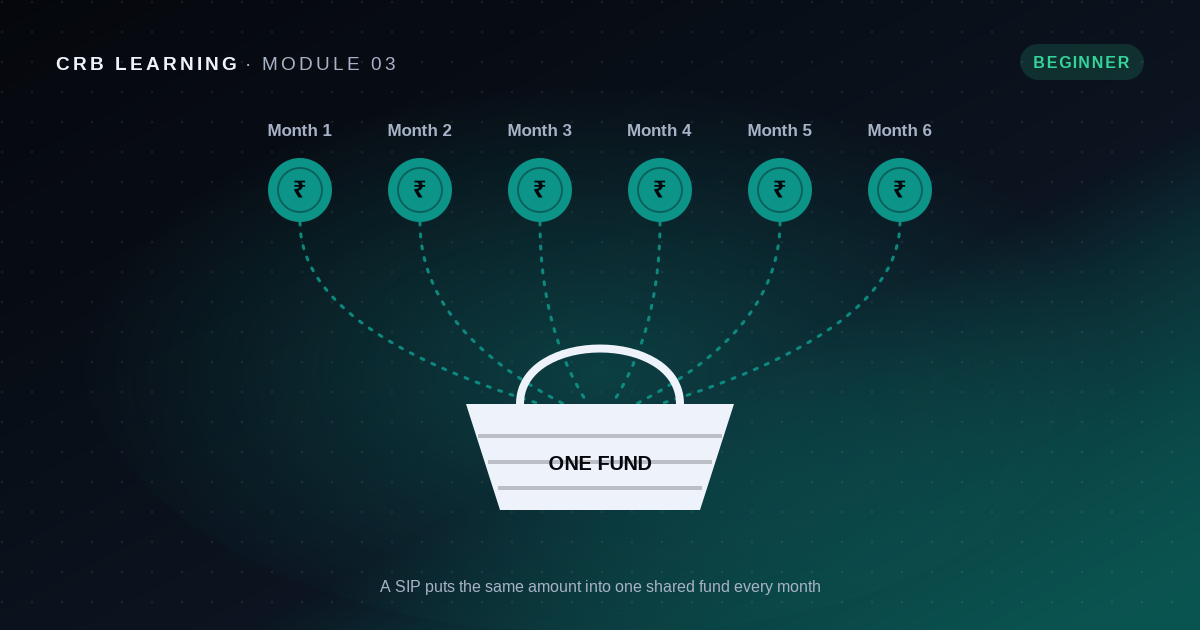
Illustration of equal monthly coins on a calendar timeline flowing into one shared basket

Why this matters

Picking individual stocks is hard. You need time, skill and a strong stomach.

A mutual fund lets you skip that. You hand your money to a professionally managed pool that owns many investments at once.

For most first-time investors in India, a simple mutual fund SIP is the most practical place to begin.

What is a mutual fund?

Imagine ten friends who each put in ₹1,000 to buy a big box of mixed fruit that none of them could afford alone. Each friend owns a share of the whole box.

A mutual fund works the same way. Thousands of investors pool money. A fund house (called an AMC, or Asset Management Company) uses it to buy shares, bonds or both.

You get units of the fund. The price of one unit is the NAV (Net Asset Value). If the investments inside the fund rise in value, the NAV rises, and so does your money.

Mutual funds in India are regulated by SEBI, and AMFI is the industry body that publishes daily NAVs.

The main types

  • Equity funds invest mostly in shares. Higher growth potential, bigger ups and downs. Best for goals five or more years away.
  • Debt funds lend to governments and companies. Usually steadier, with lower expected returns.
  • Hybrid funds mix shares and debt in one fund.
  • Index funds simply copy an index such as the Nifty 50. No star manager, low cost.
  • ELSS are equity funds with a 3-year lock-in. They qualify for a Section 80C deduction under the old tax regime.

Every fund shows a riskometer, a dial from Low to Very High. Check it before you invest.

What is a SIP?

SIP stands for Systematic Investment Plan. You invest a fixed amount on a fixed date every month, automatically.

It is like a recurring deposit, but the money goes into a mutual fund. Many funds let you start with ₹500 or less.

A SIP helps in three ways:

  • Discipline: you invest before you can spend.
  • No timing stress: you buy in good months and bad months.
  • Rupee cost averaging: you automatically get more units when prices are low.

A SIP is a method, not a product. It does not remove risk. If the market falls, your SIP value falls too.

Costs that quietly eat returns

  • Expense ratio: the yearly fee the fund charges, taken out of the NAV automatically. Index funds are usually the cheapest.
  • Direct vs regular plan: the same fund comes in two versions. A regular plan pays a commission to a distributor, so its expense ratio is higher. A direct plan has no distributor commission.
  • Exit load: a small fee if you withdraw too early, often within one year for equity funds.

A difference of even 1% a year in fees becomes a large amount over 20 years, because fees compound too.

How to start

  1. Complete your KYC with PAN and Aadhaar. It is a one-time process.
  2. Decide your goal and time frame. Short goals suit debt funds, long goals suit equity funds.
  3. Pick a category first, then a fund. Many beginners start with a broad index fund.
  4. Set up a SIP for an amount you can continue even in a bad month.
  5. Review once or twice a year. Do not check the app every day.

Real-world example

Example: how rupee cost averaging works

Rahul invests ₹1,000 a month. The NAVs here are made-up numbers to show the idea.

MonthNAVUnits bought
January₹5020
February₹4025
March₹5020

He invested ₹3,000 and holds 65 units. His average cost is about ₹46.15 per unit, even though the NAV is back at ₹50.

The dip in February helped him, because the same ₹1,000 bought more units. This is why a falling market is not bad news for someone who is still investing every month.

Key terms and what they mean

NAV
Net Asset Value: the price of one unit of a mutual fund, updated every business day.
AMC
Asset Management Company: the fund house that runs the fund.
SIP
Systematic Investment Plan: investing a fixed amount at regular intervals.
Expense ratio
The yearly fee charged by the fund, shown as a percentage.
Exit load
A fee charged if you withdraw before a set period.
Lock-in
A period during which you cannot withdraw, such as 3 years for ELSS.
AUM
Assets Under Management: the total money a fund manages.
Riskometer
The label showing how risky a fund is, from Low to Very High.

Benefits, risks and limits

What is good about it

  • Instant diversification: one fund can hold dozens of companies.
  • Professional management and strict SEBI rules on disclosure.
  • You can start small and automate everything.
  • Easy to withdraw in most funds, usually within a few working days.

Risks and limits

  • Returns are not guaranteed. Equity funds can fall a lot in a bad year.
  • Fees reduce your return every year, whether the fund does well or not.
  • Past performance does not tell you future performance.
  • Debt funds are steadier but not risk-free. They carry interest-rate and credit risk.

Common mistakes beginners make

  1. Picking a fund only because it topped last year's return chart.
  2. Stopping the SIP when markets fall, which is exactly when units are cheapest.
  3. Owning 10 similar funds and calling it diversification.
  4. Using equity funds for money needed in the next one or two years.
  5. Ignoring the expense ratio and the direct vs regular choice.

Key takeaways

  • A mutual fund pools money and spreads it across many investments.
  • A SIP builds the habit and averages your buying price over time.
  • Match the fund type to your time frame.
  • Low costs and patience matter more than finding the "best" fund.

Frequently asked questions

Is a SIP safe?

A SIP is only a way of investing, so its safety depends on the fund you choose. A SIP in an equity fund will go up and down with the stock market. It reduces timing risk, not market risk.

What is the difference between a mutual fund and a SIP?

A mutual fund is the product you invest in. A SIP is one way to invest in it, by putting in a fixed amount regularly. The other way is a lump sum, where you invest everything at once.

Can I stop or pause a SIP anytime?

Yes, in most funds you can pause, stop or change your SIP amount without a penalty. Units in ELSS funds stay locked for three years from each instalment.

What is an index fund?

An index fund copies a market index such as the Nifty 50 instead of trying to beat it. It holds the same companies in the same proportion, so costs are low and returns stay close to the index.

How are mutual fund gains taxed?

It depends on the fund type and how long you hold it. Our lesson on taxes and charges explains the current rules for equity and debt funds.

Sources and further checking

Examples use made-up or rounded numbers unless a date and source are given. Rules, rates and contract details change, so confirm them with the official source before acting. This lesson is for education only and is not investment, tax or legal advice. See the disclaimer.