Skip to content
Chang Research
Live

MODULE 02 · Start from zero

How the Stock Market Works: From Your Phone to the Exchange

How NSE and BSE actually work: who trades, how a price is set, market hours, order types and what happens after you click buy.

Beginner7 min readIndia-focused examples

Published by Chang Research Base · Last reviewed · Educational content, not investment advice (disclaimer)

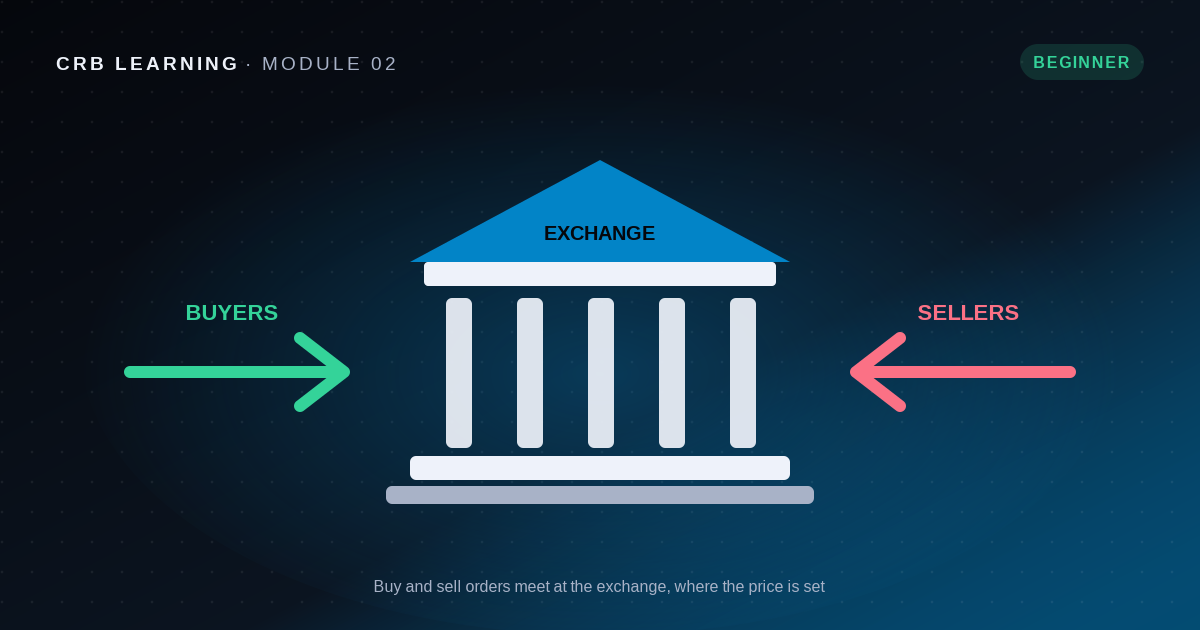
Illustration of a stock exchange building with buy and sell arrows meeting in the middle

Why this matters

You tap "Buy" on an app and a share lands in your account. It feels like magic, but a lot happens in between.

Once you understand that journey, the market stops feeling like a casino. You will know who is on the other side, why prices move and which button to press.

The stock market is a big, organised marketplace

A share is a small piece of ownership in a company. The stock market is where people buy and sell these pieces.

Think of a vegetable market. Sellers want a high price, buyers want a low price, and the price settles where they agree. The stock market does the same thing, just electronically and millions of times a day.

India has two main exchanges:

  • NSE (National Stock Exchange). Its main index is the Nifty 50, which tracks 50 large companies.
  • BSE (Bombay Stock Exchange), set up in 1875. Its main index is the Sensex, which tracks 30 large companies.

Both are regulated by SEBI, the market watchdog that makes the rules and protects investors.

Who does what when you buy a share

  • You place the order on a broker's app.
  • The broker sends your order to the exchange. You cannot trade on an exchange directly.
  • The exchange matches your buy order with someone's sell order.
  • The clearing corporation makes sure the buyer pays and the seller delivers.
  • The depository (NSDL or CDSL) holds your shares electronically in your demat account.

Settlement in India follows T+1. If you buy on Monday, the shares reach your demat account on Tuesday (the next working day).

How a share price is decided

Nobody "sets" the price. It comes from demand and supply.

At any moment there are two prices on your screen:

  • Bid: the highest price a buyer is offering right now.
  • Ask (or offer): the lowest price a seller will accept right now.

The gap between them is the bid-ask spread. Popular stocks have a tiny spread. Rarely traded stocks have a wide spread, which makes them costlier to get in and out of.

More buyers than sellers pushes the price up. More sellers than buyers pushes it down. News, results and mood change that balance every second.

Market hours

The equity market is open Monday to Friday, except exchange holidays.

  • Pre-open session: 9:00 am to 9:15 am. Orders are collected and an opening price is worked out.
  • Regular trading: 9:15 am to 3:30 pm. This is when most buying and selling happens.
  • After 3:30 pm: a short closing session follows.

Exchanges do adjust session details from time to time, so check NSE's market timings page for the latest schedule and holiday list.

Order types you will actually use

OrderWhat it doesGood for
Market orderBuys or sells right now at the best available price.Speed. You get in, but the price may be slightly different from what you saw.
Limit orderBuys or sells only at your price or better.Control. It may not get filled if the price never reaches your level.
Stop-loss orderTriggers a sell (or buy) when the price hits a level you set.Protection. It limits your loss if the trade goes wrong.

You will also choose between delivery (you hold the shares in your demat account) and intraday (you must close the trade the same day).

Who else is in the market

  • Retail investors: individuals like you.
  • DIIs (Domestic Institutional Investors): Indian mutual funds, insurance companies and pension funds.
  • FIIs / FPIs (Foreign Institutional or Portfolio Investors): overseas funds investing in India.
  • Promoters: the founders or controlling owners of a company.

Institutions move huge amounts, so their buying and selling often sets the mood for the day. You can see daily FII and DII numbers in our daily market report.

Safety brakes: exchanges use circuit limits. Many individual stocks cannot rise or fall beyond a fixed band in one day, and if the whole index moves 10%, 15% or 20%, trading is paused across the market.

Real-world example

Example: buying one share step by step

Arjun wants to buy shares of a large company. The prices below are made up for this example.

  1. His app shows Bid ₹499.80 and Ask ₹500.00.
  2. If he places a market order for 10 shares, he buys at about ₹500.00, the best selling price available.
  3. If he places a limit order at ₹498, nothing happens until some seller agrees to ₹498. It may fill later, or not at all.
  4. He buys at ₹500 and sets a stop-loss at ₹480. If the price falls to ₹480, a sell order is triggered, and his loss is limited to about ₹20 a share.
  5. The next working day, the 10 shares appear in his demat account.

Key terms and what they mean

Share / stock
A small unit of ownership in a company.
Exchange
The regulated marketplace (NSE, BSE) where orders are matched.
Broker
A SEBI-registered firm that sends your orders to the exchange.
Demat account
An electronic account that holds your shares.
Index
A basket of stocks, like the Nifty 50, used as a scorecard for the market.
Bid-ask spread
The gap between the best buying price and the best selling price.
Volume
How many shares were traded in a period.
Circuit limit
The maximum a stock or index may move in a day before trading is restricted.

Benefits, risks and limits

What is good about it

  • Anyone can own a slice of large businesses with a small amount of money.
  • Prices are transparent and trades are settled by a regulated system.
  • Shares are usually easy to sell when you need the money.

Risks and limits

  • Share prices can fall sharply and stay down for years.
  • Thinly traded stocks have wide spreads and can be hard to sell.
  • A stop-loss can fill at a worse price if the stock opens with a big gap.

Common mistakes beginners make

  1. Using market orders in stocks with very low volume and paying a bad price.
  2. Buying "intraday" by accident and getting squared off the same day.
  3. Thinking a low share price means a cheap company. ₹20 can be expensive and ₹2,000 can be cheap.
  4. Trading through unregistered people or apps instead of a SEBI-registered broker.

Key takeaways

  • Prices come from buyers and sellers, not from the exchange.
  • Your order goes broker → exchange → clearing → depository.
  • Use limit orders for control and stop-losses for protection.
  • Regular trading runs 9:15 am to 3:30 pm, and shares arrive the next working day.

Frequently asked questions

What is the difference between NSE and BSE?

They are two separate exchanges that list many of the same companies. NSE has higher trading volumes and runs the Nifty 50. BSE is older and runs the Sensex. For a beginner, the price difference between them is tiny.

Do I need both a demat and a trading account?

Yes. The trading account places your orders and the demat account stores your shares. Most brokers open both together in one application.

Can I lose more than I invest in shares?

If you buy shares with your own money for delivery, the most you can lose is what you paid. Losses can exceed your capital only when you use leverage, such as intraday margin or futures and options.

Why did my order not get executed?

Most likely it was a limit order and the price never reached your level, or the stock was stuck at a circuit limit with no sellers or buyers available.

Sources and further checking

Examples use made-up or rounded numbers unless a date and source are given. Rules, rates and contract details change, so confirm them with the official source before acting. This lesson is for education only and is not investment, tax or legal advice. See the disclaimer.